I. Historical documents from the former library of Bishop Ghenadie Enăceanu
At the Manuscripts and Rare Books Department of the Romanian Academy Library in Bucharest, a prestigious institution steeped in tradition 1, alongside other important materials 2, one can also consult the Historical Documents collection 3, which contains items of great value to national and world history, which are of interest for their content and form, as well as their age and rarity. Consisting largely of donations made to the library since its foundation by lay and ecclesiastical figures (including hierarchs such as Dionisie Romano, Iosif Naniescu, Ghenadie Enăceanu, etc.), as well as from acquisitions, the collection comprises original documents, copies or translations covering a diverse range of subjects, which shed further light on political, socio-economic and cultural-religious history, representing true treasures of universal cultural heritage 4.
In this study, we shall refer to several historical documents that belonged to the learned hierarch Ghenadie Enăceanu, Bishop of Râmnic between 1886 and 1898, the 140th anniversary of whose enthronement will be marked in 2026. These items are currently held at the Library of the Romanian Academy in Bucharest, where they were transferred following his death 5, along with other valuable materials, such as personal documents, letters, manuscripts in Romanian, Slavonic and Greek, old printed works and leaflets, etc. We note, very briefly, that Bishop Ghenadie was originally from Iași, born around 1835 6. He studied at St Sava, at the National School of the Three Hierarchs in Iași, then at the Seminary in Socola, continuing his education at the Theological School on the island of Halki and subsequently at the Spiritual Academy in Kiev. He worked as a seminary lecturer (in Buzău and Bucharest, eventually becoming head of the Nifon Seminary) and as a university lecturer (he served as dean of the Faculty of Theology in Bucharest), taught church history, philosophy and Greek, and wrote works on history and theology 7; his involvement in scholarly work has been highlighted by various contemporary authors, who regarded him as a great scholar and lover of books 8. To complement this aspect of his personality—namely, his love of culture—we propose to present, in turn, some of the materials that Bishop Ghenadie Enăceanu held in his library, which demonstrate the hierarch’s interest in historical sources, his care in collecting and preserving them, and his commitment to researching historical sources directly – which, of course, requires a certain level of expertise in the field.
In the ‘Historical Documents’ collection, we have identified around 1,200 items, dating from the 15th to the 19th centuries, comprising originals or copies, some of which also include translations, written on parchment or paper in Church Slavonic, Greek, Latin and Romanian, using Cyrillic script, and bearing various marks of validation (hanging seals, stamped seals, fixed or movable 9), heraldic symbols, autograph signatures, princely monograms 10 in chinovar 11 or in gold liquid, and beautiful miniatures. In terms of type, these are official documents, charters 12 issued by the princes of Wallachia, or private documents, deeds, contracts of sale and purchase, exchange agreements, land demarcation documents, letters addressed to the bishops of Râmnic or their correspondence with the metropolitans of Ungrovlahia or with other members of the ecclesiastical community, such as abbots, monks and archpriests, etc. We also find registers of certain monasteries, usually drawn up, as was the custom, upon a change of abbot, or documents through which an abbot made a paretesis. For example, the original document dated 23 March 1805 has been preserved, in which Platonida, the abbess of the Dintr-un Lemn Monastery, informed the hierarch of Râmnic that she was stepping down from her post and recommended the nun Pelaghia (13) to succeed her. A few months later, on 24 June 1805, an inventory/catastih was drawn up of the movable and immovable property of the same convent, led by Pelaghia Olănescu 14. Also amongst the documents belonging to Bishop Ghenadie Enăceanu was the original diploma, written in Latin, issued by Charles VI of Habsburg, Emperor of the Holy Roman Empire (1711–1740) and sovereign of Oltenia (1718–1739), confirming the election of Ștefan15—at that time abbot at Govora—as Bishop of Râmnic on 15 October 1726 16. The Academy Library also holds, again from Bishop Ghenadie Enăceanu, original charters from the princes of Wallachia – Vlad IV the Monk, Radu Paisie, Mircea the Shepherd, Petru the Younger, Mihai the Brave, Matei Basarab, Grigorie I Ghica, Radu Leon, Gheorghe Duca, Antonie Vodă of Popești, Constantin Brâncoveanu, Mihai Racoviță, Ștefan Racoviță, Constantin Mihai Cehan, Mihai Suțu, Nicolae Petre Mavrogheni, Constantin Moruzi, Alexandru Ilpsilanti, Constantin Ipsilanti, etc. The oldest charter we have identified in Bishop Ghenadie Enăceanu’s collection dates from 12 May 1483 17 and was issued in Târgoviște by Vlad IV the Monk (1481–1495), in favour of a boyar, Dragomir the Steward, whilst the most recent chancery document is that of 4 September 1824 18, by which Grigorie IV Ghica, Prince of Wallachia (1822–1828, the first native prince following the events of 1821), confirmed to the Diocese of Râmnic several of its ancient fiscal privileges, including the right to collect revenue from wine duties 19, tolls 20, salt, etc. Among the documents we also find decisions by the Craiova bans (such as that of Antonache Calimachi from 1743 21) or by the imperial administration, during the period when Oltenia was under Habsburg rule (for example, a document from 1724 22), ledgers of the border boyars (for example, the one from 1764 23), wills (that of the serdar 24 Ioan Slătineanu, a Greek copy from 1780 25, the deed of Isaia, the abbot of Dobrușa, undated 26), deeds of dedication of certain monasteries or hermitages to the Diocese, such as the one from 1678 27, by which Paisie the monk of Sălcuța, Dolj County, and his son, the priest Pană, dedicate the Sălcuța hermitage as a metochion of the Diocese of Râmnic. Among the documents are also certificates, receipts, petitions, anaphoric prayers, inventory-style lists of various objects, etc.
For the present article – having set ourselves the aim of highlighting the value (or rather, the value) of Bishop Ghenadie Enăceanu’s materials, rather than merely their impressive number – we have focused on several documents issued by the rulers of Wallachia in the mid- and second half of the 17th century, documents which are adorned with beautiful miniatures. In selecting the materials, we sought to ensure they shared similarities so that they could be compared. Thus, the chosen items have in common the fact that they originate from the library of the Bishop of Râmnic, that they are, typologically speaking, charters, that is to say, official documents issued by the rulers of Wallachia in the 17th century (I have thus limited them in time and space) and that they are splendidly decorated. However, I have sought to ensure they have different issuers and varied content precisely to illustrate the wealth of historical information they provide, which can be utilised through specialist studies (in history, philology, heraldry, ecclesiastical history, art history), as well as miniatures that are as distinct as possible, both in terms of subject matter and execution. Through this approach, we can gain a better appreciation of the richness of the collection held by the Library of the Romanian Academy in Bucharest, as well as the importance of the collection of the scholar-hierarch Ghenadie Enăceanu. As for the illustrations on the documents, these include floral, plant and animal motifs, as well as chimeric and iconographic elements, depicting the faces of saints and even votive paintings. Moving beyond a detailed examination of the documents’ form and content to take a broader view, we can reach interesting conclusions not only of an artistic nature, but also of a historical nature, since the charters are official documents, issued by princes—the supreme secular authority of the state—and are public, not private; consequently, they involve the state, not merely the person of the voivode.
The documents presented were issued by Matei Basarab (in 1641), Grigorie I Ghica (during his first and second reigns, on 13 January 1664, 18 April 1664 and 15 April 1672), Radu Leon (on 29 March 1665 and 8 January 1669), Gheorghe Duca (on 2 March 1674) and Constantin Brâncoveanu (on 20 September 1698), and contain confirmations of property ownership, generally relating to land, as well as immunities and tax exemptions, granted to private individuals or monasteries, and setting out matters concerning the administration of church property or the amount of tithes for priests. An analysis of these documents also reveals information about the types of property and the ways in which they were acquired, pre-emption rights, the types of dues in those days, and so on.
II. The historical and cultural-ecclesiastical context of the issuance of the charters
In short, we recall that, for the Romanian Principalities, the 17th century 28 was a distinctive period, bounded, on one end, by the reign of Mihai Viteazul (1593–1601, who had a powerful impact, both domestically and internationally, through his struggle against the Ottomans and the union of the three Romanian principalities)29 and, at the other end, by the advent of new political regimes: the Phanariot regime in Wallachia and Moldavia, and the Habsburg Empire in Transylvania. The 17th century is regarded as a transition from the late Middle Ages to the modern world, which brought about political and social changes and revitalised relations between the three Romanian Principalities, which were involved in anti-Ottoman military alliances and cooperation (the alliance during the reigns of Gheorghe Ștefan, Constantin Șerban and Mihnea III 30 or the support enjoyed by Gabriel Bethlen in his seizure of power, in 1613, from the princes Radu Mihnea of Wallachia and Ștefan Tomșa of Moldavia 31), as well as in fruitful cultural and religious cooperation.
Domestically, in Wallachia as a whole, the princely regime was replaced by that of the boyars, in the sense that princely authority was curtailed in favour of the great boyars, who vied for supremacy in government; the disastrous rivalry of the era between the Cantacuzino and Băleni factions 32 is well known, with dire consequences for the country. The election of the prince through the hereditary-elective system of earlier times was replaced by his appointment by the Sublime Porte and, consequently, the emergence of foreign princes, generally Greeks, who arrived accompanied by their associates, foreshadowing the Phanariot regime. In this context, the Assembly of the Country also saw a decline in its electoral and military powers, whilst the great army, which had been the backbone in the past, fell into decline, with mercenaries and boyar bands appearing more frequently.
Following the reign of Mihai Viteazul, anti-Ottoman action continued for a time during the first decade of the 17th century, but Turkish power would be re-established, even though economic pressure eased for a while. Following a period of cultural flourishing and political stability during the reign of Matei Basarab – marked, among other things, by collaboration with the princes of Transylvania (for example, the alliances between the Prince of Wallachia and Gheorghe Rakóczi I)33 – from the second half of the 17th century, the rivalry between the two boyar factions intensified, creating political instability. This was not to the liking of the Ottoman Empire, which was focused on operations in the heart of Europe; this, for a time, the country’s autonomy, as an attempt was made to transform it into a pashalik; this was, however, abandoned, as it was not a decision of the Sultan but the wish of the Grand Vizier. However, the country’s political and legal status in relation to the Ottoman Empire did not change; rather, the tributary protection continued, which ensured internal autonomy – aspects we shall detail, drawing in particular on the studies of the late Turkologist Mihai Maxim, when we present the charters adorned with religious symbols and Christian phrases in the text, which are true testimonies to a Christian, autonomous state where Islamic law did not apply.
On the international stage, during this period Poland’s power waned, whilst the ties between the Romanian Principalities and the Habsburg and Russian Empires were strengthened in order to counter Ottoman power; Europe was ravaged by the Thirty Years’ War (1618–1648, ending with the Peace of Westphalia and the principle of the European balance of power), forged alliances (the Christian League: 1593–1606; the Holy League: 1684–1699) and fought against the Turks, whose advance was halted at Vienna in 1683, and then at Zenta in 1697, and who imposed the Peace of Karlowitz (1698–1699), following which the Habsburg Empire annexed Hungary and Transylvania 34.
The end of the century saw the return of important rulers in the history of Wallachia – Șerban Cantacuzino (1678–1688) and Constantin Brâncoveanu (1688–1714), who achieved much in the cultural and ecclesiastical spheres 35, supporting Christians within the Ottoman Empire through donations to the Orthodox East and to Transylvania, which was under Protestant pressure and later faced the prospect of union with Rome. Numerous ecclesiastical links were maintained with the Greek- and Slavic-speaking Orthodox world, and important ecclesiastical, liturgical, theological and apologetic works were printed 36; some of these, true treasures, were also found in the library of Bishop Ghenadie of Râmnic and are currently preserved at the Library of the Romanian Academy in Bucharest 37.
III. Documents decorated with plant and zoomorphic miniatures
A beautiful initial, adorned with floral elements in chinovar, is found on the Slavonic parchment issued by Matei Basarab 38 in 1641 39, by which the voivode confirms to Necula Cupar 40 and his brother Chisar several estates, mostly in Vâlcea County, including Sărăcinești 41, Mihăiești 42, Păușeștii de Râmnic 43, Buneștii de Sus 44 and Viespari 45. The text is interesting because, on the one hand, it recounts the history of these properties, but also because it lists the various types of land tenure at that time. Thus, we read that: ‘Because these aforementioned estates, vineyards, neighbouring lands and Gypsies belonged to their uncle, Anghel the logothete, by inheritance, purchase and kinship. And Anghel the logothete held them all in peaceful possession until his death; and after his death, he bequeathed all his estates to his nephews, Necula the coppersmith and Chisar. And Anghel the Logothete handed over all the documents relating to the aforementioned estates, one by one, with great solemnity, to his nephews, Necula the coppersmith and Chisar. ‘Therefore, at that time, I, the ruler, saw those old documents… I, the ruler, have renewed and confirmed this with this charter of my reign’46’. Thus, the voivode, by virtue of the right of ‘domnium eminens’47’, confirmed the inherited lands; the document also mentions the manner in which Anghel acquired them: inheritance, purchase and kinship, the latter being a method used to facilitate a stranger’s entry into a community, without infringing upon the right of pre-emption of relatives and villagers over certain estates 48. We recall that ‘fraternity’ appears in documents in two forms: ‘cross-fraternity’, which entailed only mutual assistance, and ‘estate-based’, with implications for property ownership and which could serve as a means of circumventing the right of pre-emption / the right of protimisis 49, a right that also arose from the community’s need to maintain control over its assets to prevent them from being alienated. The ‘frăția de moșie’ involved not only the transfer of land but also a change in social status, being similar to adoption, that is to say, leading to derogations from the common law of succession 50. The document is also of interest from a historical geographical perspective; from it we learn that the first villages listed were situated in Vâlcea County and were somewhat clustered together (Sărăcinești and Păușești, which are close to one another; today, both in the commune of Păușești-Măglași), whilst the Viespari estate was situated in Teleorman and had a different history.
The text tells us that the village of Viespari had been granted to Anghel by Voivode Radu Șerban in 1602–1603 (7111), in recognition of the loyal and faithful service he had rendered to his lordship in foreign lands 51, and so it had been acquired in return for military service, constituting a form of benefice, a practice more common in the preceding century. In Moldavia, this type of property was called vysluzenie, the Slavic etymology explaining the manner of its acquisition; it was a gift of property, a princely favour, which was not hereditary but conditional and could be revoked, particularly through ‘predalică’ (the practice of the ruler of seizing the estates of those who had no heirs), although this could be avoided, as the tendency was for the benefice to be transformed into absolute ownership. Thus, the land granted for faithful service (52) differed, even etymologically, from ‘ocină’, ‘baștină’ and ‘dedină’, which referred to land inherited from parents or ancestors; these latter terms also appear in the charter of 1641.
The charter was written by Soare the logothete, an active scribe of the time, in the provincial capital of Târgoviște, in 1641 (7149), without mention of the day or month, but was dated by the editors as prior to 3 April, following analysis by members of the Divan of that time. The miniaturist, however, is not specified. Beneath the text is a beautiful ornate initial rendered in chinovar, adorned with plant motifs, in the same style as the letrina. The document is authenticated by a princely wax seal, affixed in such a way that the silk threads are joined on the writing surface and on the seal flap 53, forming the sign of the Holy Cross.
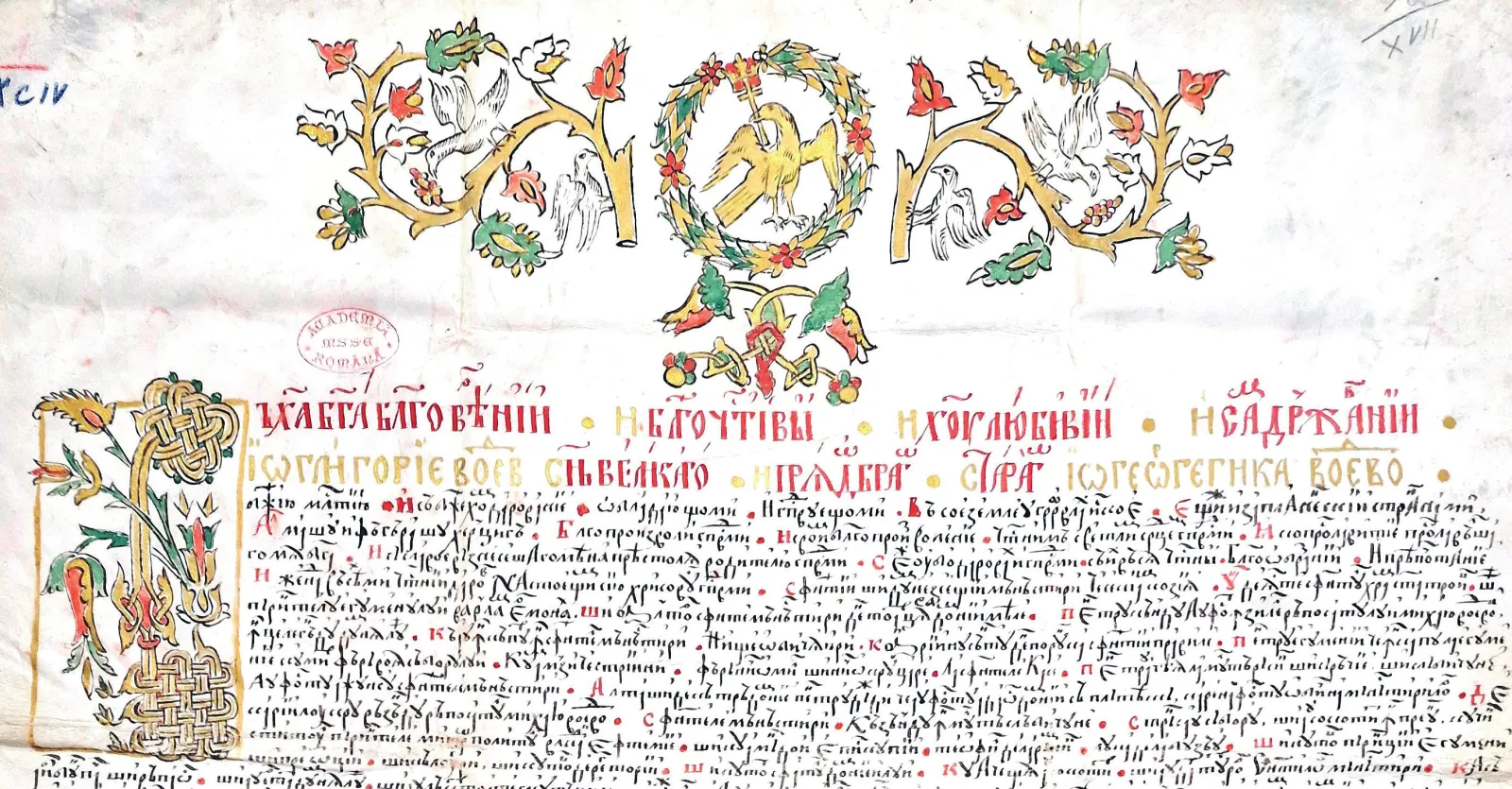
In a document issued on 18 April 1664, Grigorie I Ghica 54 confirmed to Cozia Monastery (led by Varlaam, future Bishop of Râmnic from 1670 to 1672 and subsequently Metropolitan of Ungrovlahia from 1672 to 1679 55) and to other monastic settlements in Wallachia, the older regulations concerning the administration of property, the election of abbots, and the way of life within the community—provisions previously stipulated by the synod held during the reign of Mihai Viteazul (1593–1601) and by Metropolitan Eftimie 56. Written on parchment in Romanian by Dumitrașco, the scribe, the document is adorned on the frontispiece with white and red flowers on branches coloured ochre, with green leaves; the artist has sketched, symmetrically, and two white doves each, with outstretched wings, suggesting elegance and movement. Between them is the country’s coat of arms, the eagle in flight, holding a cross in its beak, at the end of which is an open crown with fleurons. The coat of arms’ border is circular, formed of floral and plant motifs in the same shades. The text begins with an initial letter adorned with floral elements and interlacing, which are highly interesting and not very commonly found in chancery documents (reminding us rather of the ornamentation in manuscripts, for example, the initial letters of the Slavonic Manuscripts nos. 651, f. 69r, and No. 13, f. 235r, respectively, held at the Library of the Romanian Academy 57), the composition being framed within a border. The title is written in red ink and gold liquid, whilst the princely monogram is in cinnabar. The prince signed the document in his own hand, beneath the text on the left-hand side, and the princely seal, a movable stamp, was affixed to the document; the sheet on which it was placed was sewn to the document with blue silk.
The presence of birds is not entirely uncommon in the illustrations of charters of that period; they also appear on Wallachian documents from the time of Matei Basarab, preserved at the National Archives 58. Moreover, the deer motif – which we find on the initial of the document dated 29 March 1665 – also appears on the princely monogram of a charter issued by Matei Basarab on 20 October 1639, written by Mihalcea, the logothete, but decorated by Bogza; the original is currently preserved at the National Archives in Bucharest 59. In the same document from 1639, we also find birds of various types and in different positions.
Through the act of 1664, Grigorie I Ghica, together with Metropolitan Ștefan 60, Bishops Ignatie of Râmnic 61 and Serafim of Buzău 62, and the boyars, reinforced the provisions laid down by Mihai Viteazul, who, seeing the impoverishment of the monastic communities due to excessive levies, the negligence of certain abbots and certain bad customs, which are not in accordance with the Holy Canons 63, had convened a synod and, together with Metropolitan Eftimie 64 and the bishops Teofil of Râmnic 65 and Luca of Buzău 66, had decided to exempt the monasteries from taxes and stipulated that abbots 67 should be elected by the synod from amongst the monastic community or from those accepted by them, so as to prevent abbots who were indifferent to the community’s property and problems from coming to power. Given that this document and the previous ones were also signed by the hierarchs, it is clear that the rulers were seeking exclusively to put an end to abuses (under the specific circumstances of the period) and to prevent the mismanagement of church assets, rather than removing places of worship from the authority of the local bishops or disregarding the hierarchy, as stipulated by the canons of the Ecumenical Councils, but also by other decrees issued within the Romanian realm, which emphasised the bishops’ duty to ensure good order in monasteries, permitting the removal of unworthy abbots 68. Other provisions concerned the prohibition on monks leaving for another monastic community or even into the wilderness without the blessing of the abbot and the council: no monk was to be at liberty to leave his cell 63, and anyone who did so was to be excommunicated 63; monks were not permitted to accumulate any personal possessions, nor to steal, nor to conceal anything, nor was the abbot to incur expenditure without the consent and knowledge of the inhabitants of that monastery. Other provisions concerned the obligation of the voivodes to protect the monastery’s property and to repay any loans taken out in times of need.
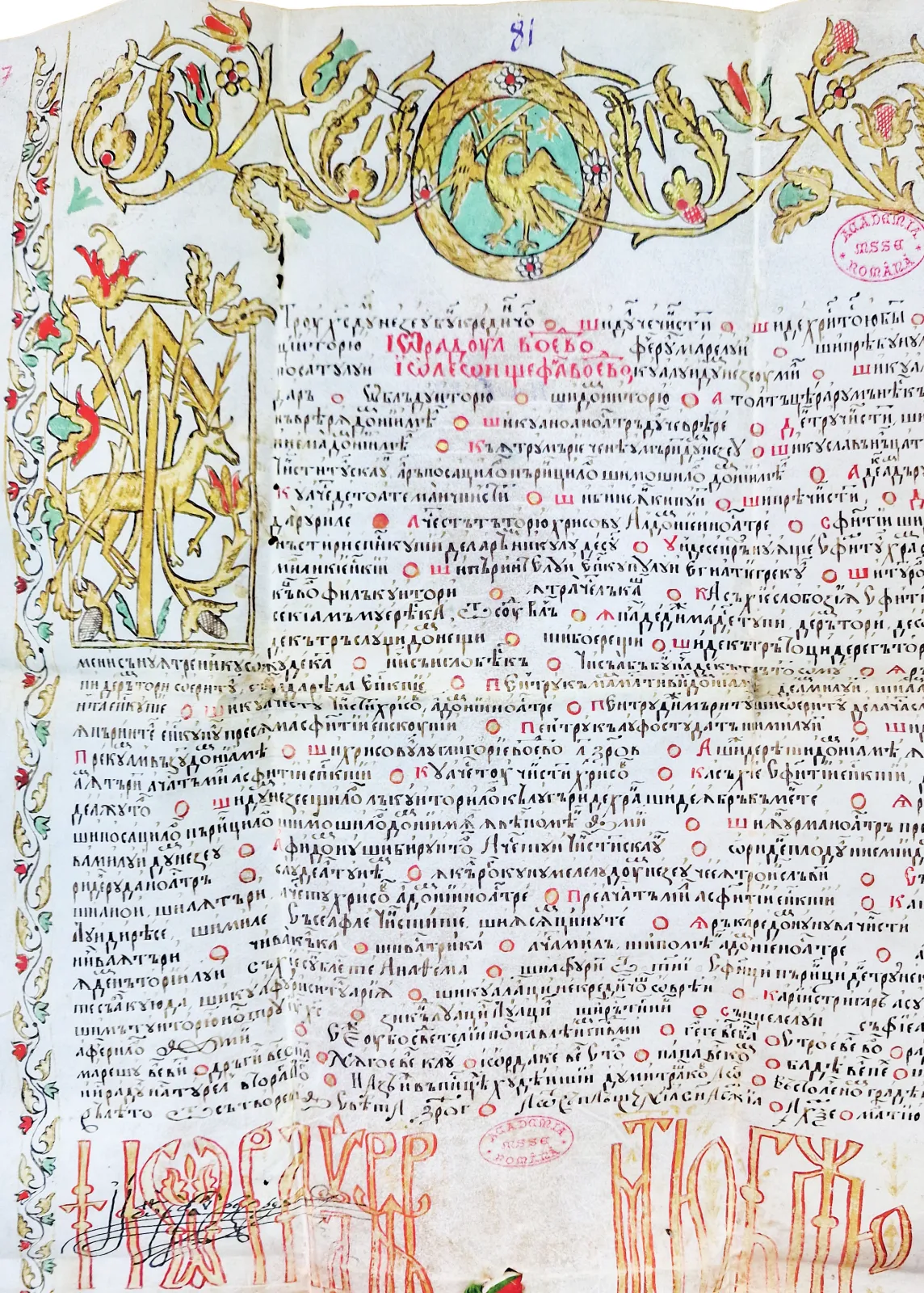
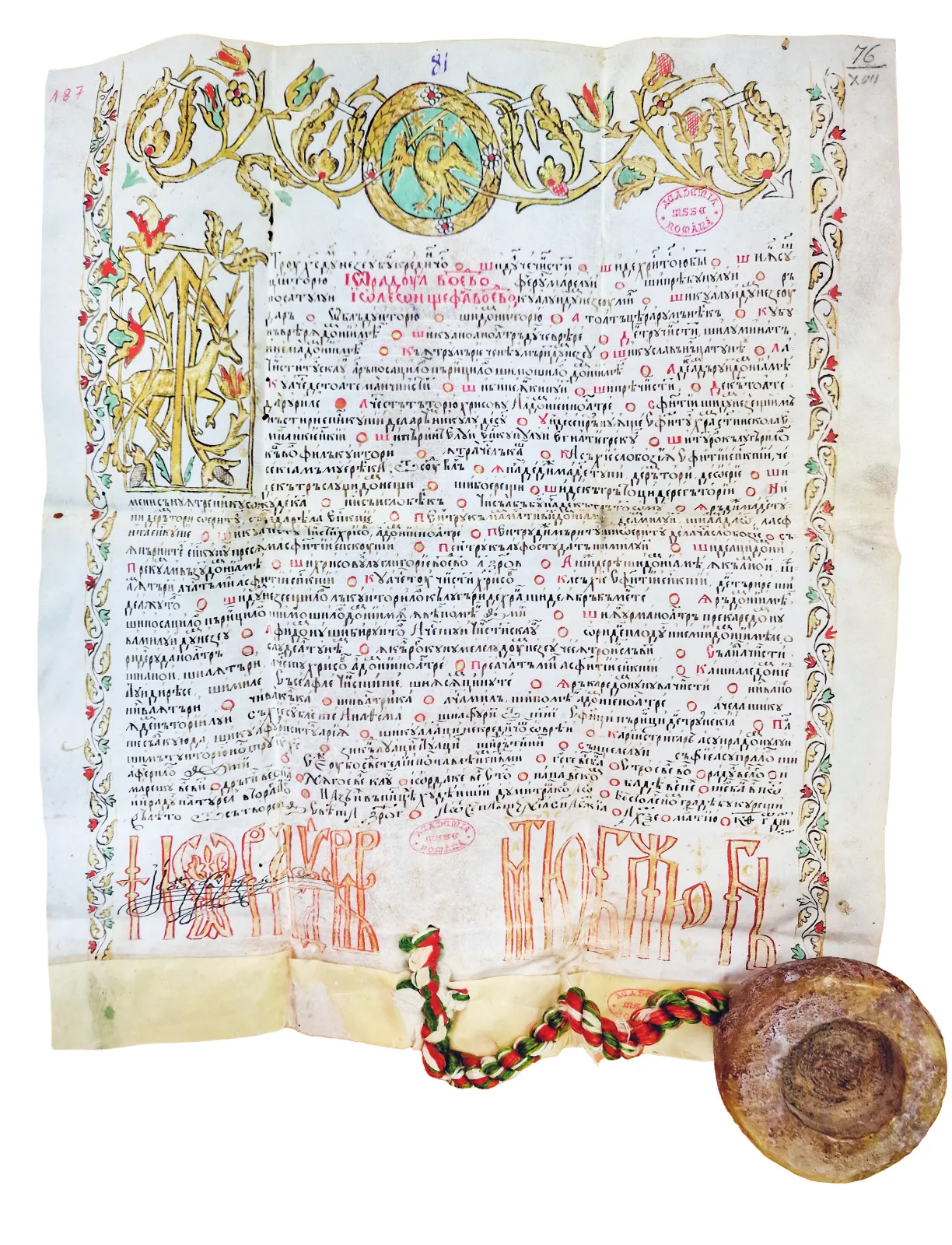
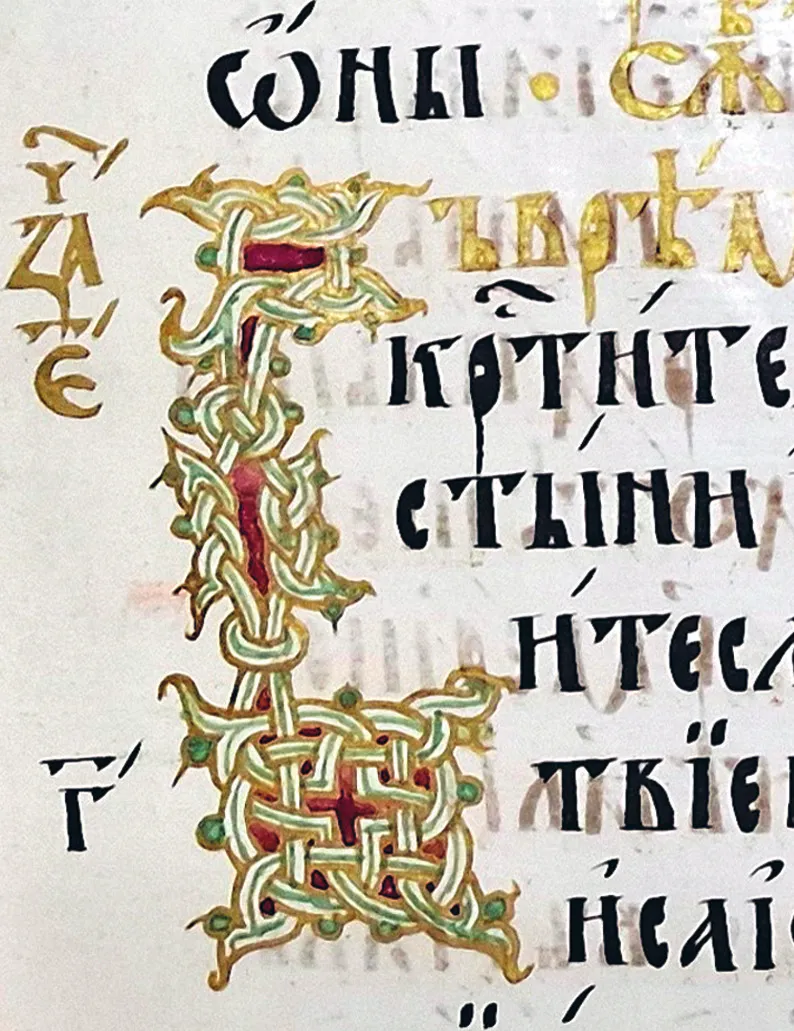
Among the charters bearing hanging seals (included in the ‘Seals’ collection), we should also mention a document dated 29 March 1665, issued by Radu Leon69, whereby he exempted the village of Muereasca in Vâlcea County, belonging to the Diocese of Râmnic, from taxes. The document is interesting both for its content and its form, featuring beautiful miniatures executed in coloured inks. Written on parchment in Romanian using Cyrillic script, yet retaining a few Slavonic phrases, the text itself is framed on either side by a border, with the country’s coat of arms—the crossed eagle—centred on the frontispiece, set within a round shield flanked on both sides by floral motifs. The initial letter with which the title begins (Î, from ‘Întru Hristos Dumnezeu’ [70]) is splendidly decorated with plant motifs (flowers, acorns), as well as zoomorphic ones (a stag depicted in motion, running)—details rarely used to illustrate chancery documents. The images are rendered in shades of brown, ochre, red and green. Beneath the text, the prince’s monogram is preceded by a cross and followed by his autograph signature, written in black ink. The document was issued by the prince in favour of ‘the holy and divine monastery, the diocese of Râmniculu de Sus, where the feast day of Saint Nicholas Mirlichienschii is celebrated, and to Bishop Egnatie the Greek, and to all the monks who may dwell in this sanctuary, so that the holy bishopric known as Muereasca, south of Vâlcea, may be exempt, in peace, from the tithe on beehives, beekeepers, sheepfolds and from the lord’s and boyars’ servants, as well as from all the officials of 71, no one shall bring any legal action against them, nor shall they be burdened; they shall enjoy full peace from all men. Furthermore, the tithe from beehives and apiaries, and from sheep farming, shall be paid to the bishopric. ‘For I, the Lord, have shown mercy by granting this favour and adding to the holy bishopric; and by this honourable charter of Our Lord, concerning the tithes and sheep-herding from this freehold, let the bishop take them into the account of the holy bishopric’70 The exemption was granted to strengthen and assist the holy bishopric and to provide the divine monks residing there with food and clothing 72, and to the voivode and his late parents, for eternal remembrance. The village of Muereasca is referred to in the text as a ‘slobozie’ 73, which, as the etymology also indicates, a settlement whose inhabitants, whether native or foreign, enjoyed certain tax privileges, having been exempted by the voivode from part of the taxes and duties owed to the principality for a specific period; in this instance, the revenues from the tithe on beehives, beekeepers and sheep farming 74 were ceded to the Diocese of Râmnic. Also listed is the prohibition on royal or boyar officials from judging villagers and imposing fines on them 75, that is, from levying any fines, which meant that these rights also fell to the Diocese. Thus, for a certain period of time, the voivode ceded certain rights and revenues that were due to the principality to the Diocese.
The document was written by Dumitrașco, the logothete, whilst the miniaturist is not mentioned; the latter might sometimes have been the same person as the scribe, but in most cases was a different individual; he might have been a local or from other regions of Slavonic or Greek Orthodoxy. We should also note the mention of the hierarch of Râmnic at that time, Igantie the Greek (of Greek origin), who served as whilst Stephen I (1648–1653, 1655–1668) was Metropolitan of Ungrovlahia. Furthermore, at the time the document was issued, in 1665, Greek influence in Wallachia was significant (and thus possibly extended to the miniaturists as well), the prince himself being of Constantinopolitan origin, named Dimitrie, nicknamed Stridie, but declaring himself the son of Leon Tomșa, who had been appointed by the Ottoman Empire to lead the country for strategic reasons76. In the charter, Radu Leon specified that he was confirming the privileges of the village of Muereasca as he had read them in a document from Grigorie Ghica dated 1664.
Among the documents at the Academy Library originating from Bishop Ghenadie Enăceanu, the original from 1664, which Radu Leon had seen, has also been preserved; this is the charter dated 13 January 1664 77, by which Grigorie I Ghica had exempted those villagers from taxes; a similar document was issued on 8 January 1669 78 by Radu Leon.
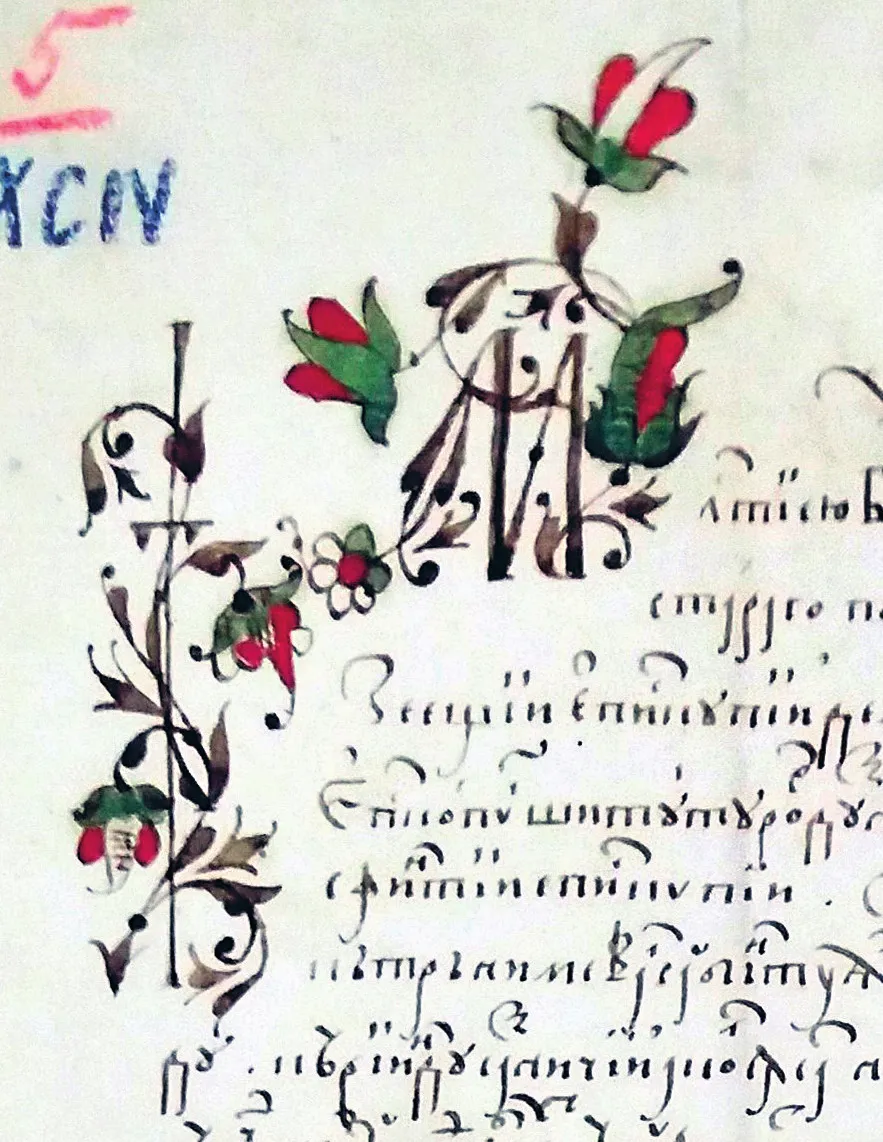
The initial letter ‘M’ from the Slavonic form of the formula of devotion, by which the voivode declared that he ruled by the grace of God, appears beautifully framed by large flowers, in a bouquet ranging in shades from pale red to pink, in a document by Constantin Brâncoveanu (1688–1714), issued on 20 September 1698. The text was written by Isar79, the junior scribe, a well-known copyist of the time, and the document is also adorned at the top with floral motifs in the same colour scheme, arranged symmetrically on either side of the princely monogram, written in cinnabar, with a princely seal, a movable stamp, affixed between its two phrases to authenticate the document; this validation is further reinforced by the prince’s autograph signature, situated on the left within a stylised cartouche. The document was issued in favour of all the priests and deacons residing within the Diocese of His Holiness, our Father Kir Ilarion 80, Bishop of Râmnicul de Sus, throughout the five counties beyond the River Olt, namely: Vâlcea, Românați, Dolj, Gorj and Mehedinți, all the priests and deacons under the care of His Holiness 81. To these, the lord granted them a charter 82 and a settlement, so that they and their families might be exempt from the taxes levied throughout the country, and that they might pay a tax amounting to two thousand eight hundred ughi 83, payable in four equal instalments, on the dates specified in the text, whilst the tithe, sheep tax and wine tax are to be paid in cash, and they shall be exempt from all other taxes and levies, that is to say, they shall not be pressured by officials to pay. The reason for this privilege is that the priests and deacons had come to the Prince, asking him to grant them exemptions, in order to ease their burden of payment, and the prince granted them this charter, so that they might have respite to serve the Holy Churches, to pray for My Reign and for all Christians 81.
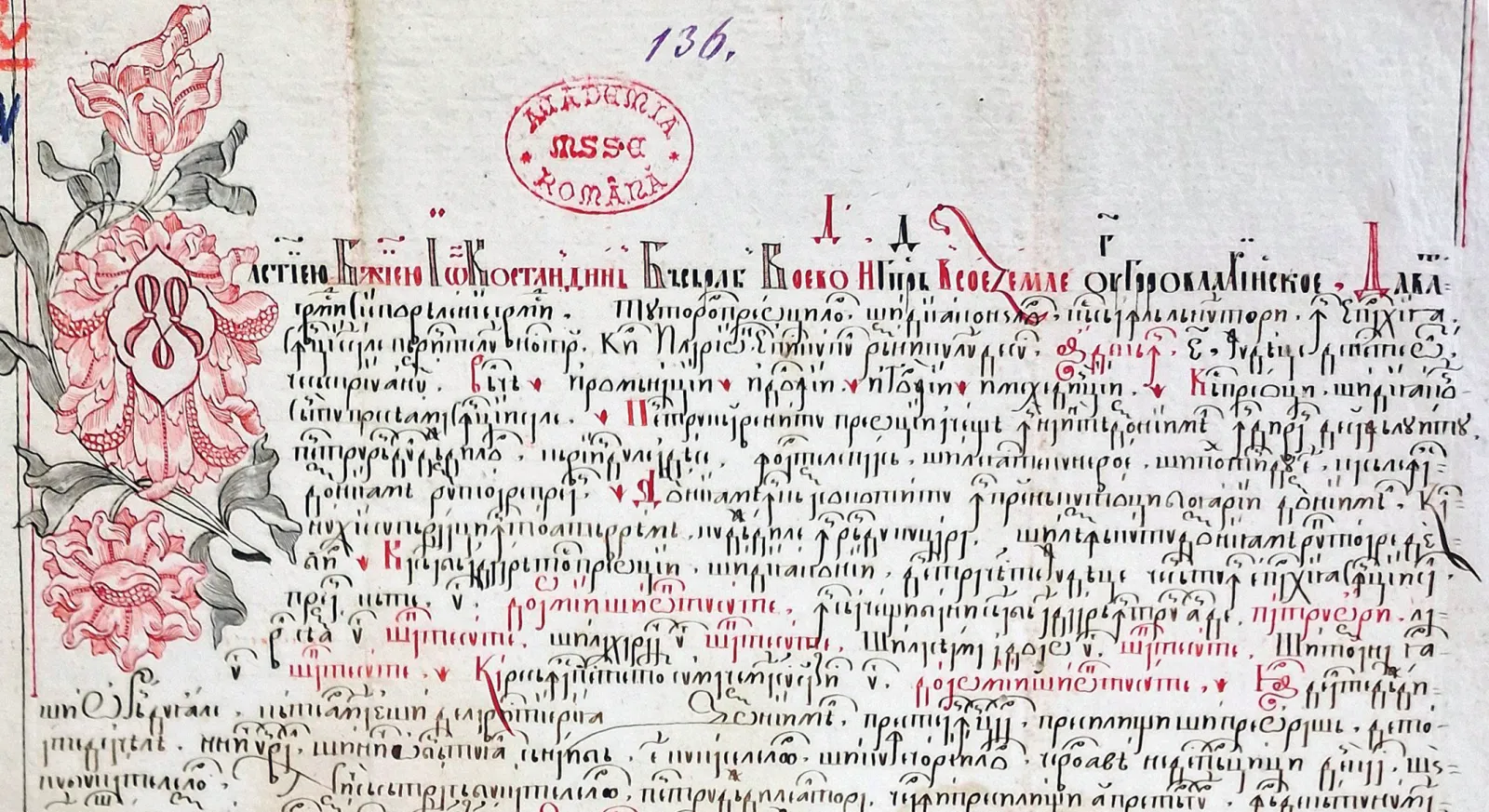
The document, which also originates from the library of Bishop Ghenadie Enăceanu, is significant both for its miniatures and for its content, which details the extent of the Diocese of Râmnicul de Sus, comprising the five counties across the River Olt, the name of the hierarch at that time, Ilarion, the dues and privileges of the priests and deacons, listed by name, the coins, the due dates and certain methods of payment, as well as the name of the scribe, who was very active during the reign of Constantin Brâncoveanu. In July of the same year, Isar the logothete, acting on Brâncoveanu’s orders, had drawn up a document similar in both content and form (with the initial enclosed within a floral composition, featuring a similar decoration); the document, the original of which is preserved at the National Archives in Bucharest 84, tells us that the prince decreed that all priests and deacons in the nine counties of the diocese of the Metropolis of Ungrovlahia, overseen by Metropolitan Teodosie (Ialomița, Prahova, Ilfov, Dâmbovița, Vlașca, Teleorman, Mușcel, Argeș, Olt), should pay a tax amounting to 7,000 ughi per year, whilst being exempt from other levies. Thus, both charters – which complement one another – reveal the voivode’s policy of alleviating the tax burdens on parish priests in Wallachia. Beyond their significance for the study of miniatures – in terms of style, subject matter and colour palette – they provide us with information about the Wallachian hierarchy of the time, the chancellery officials and the voivode’s domestic policy in relation to the Church.
IV. Documents adorned with iconographic miniatures, votive portraits and fantastical elements
Another category of historical documents with miniatures originating from Bishop Ghenadie Enăceanu are those decorated with images of saints. In our previous works devoted to this type of document, we noted that the pieces adorned with icons 85 constitute a distinct category of chancery documents which, beyond their beauty and the text itself, with their varied content, these documents, when examined as a whole, constitute genuine testimonies of a Christian state, of a society with a Christian mindset and political ideology, modelled on the Byzantine system of government. In this sense, they also serve as evidence of the autonomy of the Romanian Principalities in relation to the Ottoman Empire, for they feature Christian symbols in their iconography (the sign of the Holy Cross, icons) and quotations from Holy Scripture in the text, and were issued and signed in the prince’s own hand, that is, by the supreme and secular authority of the state, who publicly declared that his power came from the mercy of God, validating the documents with the princely seal; the Wallachian state coat of arms being an eagle with a cross in its beak 86.
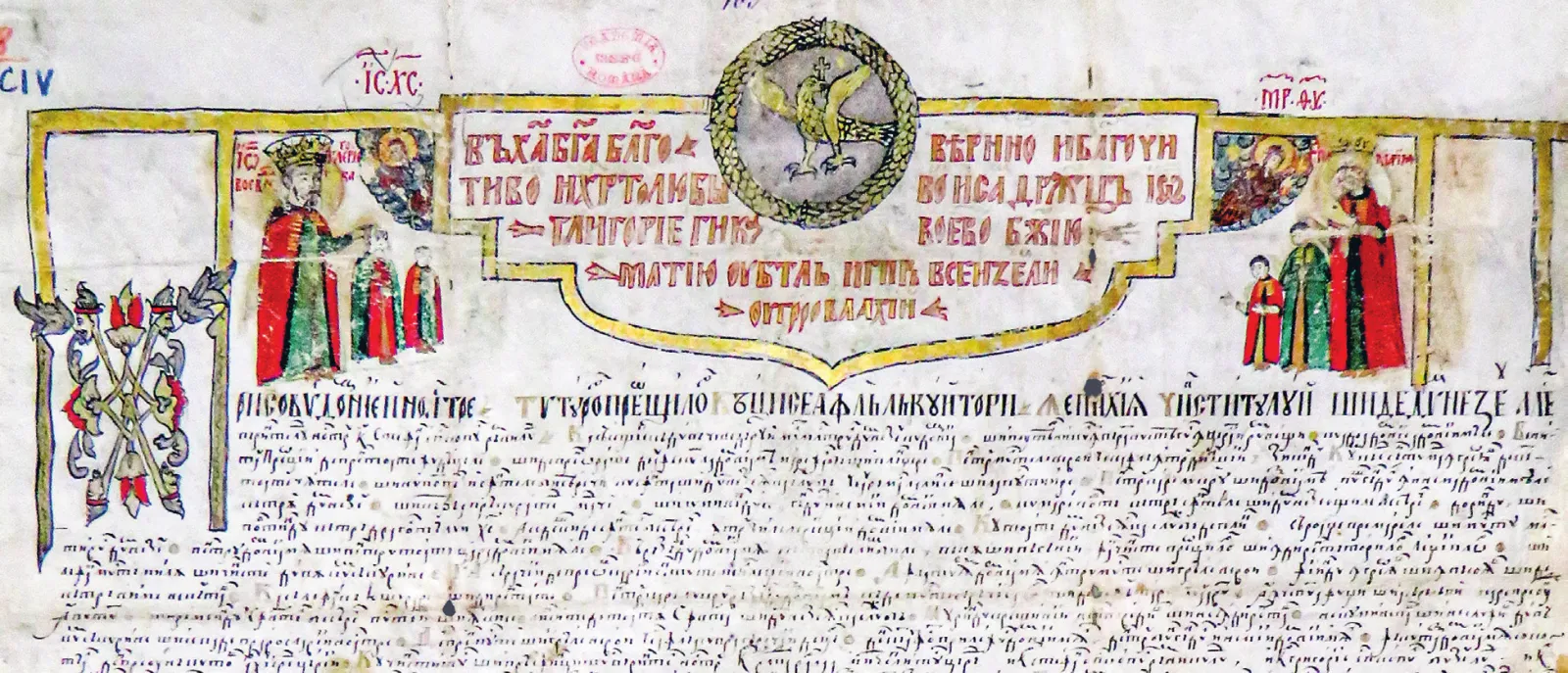
The Academy Library holds several charters from the Bishop of Râmnic, adorned with images of saints 87. One of these is the document dated 15 April 1673 88, by which Grigorie I Ghica granted parish priests exemption from taxes, stipulating that they were to pay a single sum at the time of the haraci tax, amounting to 750 ughi and the flag tribute, but not the tax on draft horses, cart fees or the ‘mertice’ tax. Furthermore, the use of priests as servants of the prince or the boyars was prohibited: ‘And no one shall be permitted to conscript priests, neither as servants of the prince nor of the boyars, for the land tax or for service’ (72). The decision was taken by the prince in agreement with the great and lesser boyars and with the blessing of the hierarchs mentioned in the text, namely: Metropolitan Varlaam, and the bishops Stephen of Râmnic, Gregory of Buzău and Daniel of Strehaia 89, and the reasoning behind it was most commendable, namely the honour to which they ought to be entitled, rather than the excessive burden which had led to their impoverishment and dispersal, to the detriment of the Christians, who were dying without having confessed their sins or received Holy Communion. The text is written on parchment, but as the ink has partially faded, we have also made use of a copy of the document, transcribed into a register, also from the old library of Bishop Ghenadie Enăceanu, produced in 1786 by the renowned scribe and miniaturist Dionsie Ecleziarhul, which is itself beautifully decorated and bears, on its first page, the seal of Bishop Ghenadie of Râmnic. Also preserved in the Historical Documents collection, the register contains 326 documents, the first of which dates from 1673, from which we learn that: ‘Priests have come from all the counties and towns, and have made a great plea and complaint to My Lordship concerning the many hardships they face, saying that they are more burdened than all other groups and cannot guard the holy churches … seeing as I do that all peoples, even the pagans, honour the priests … and show them much mercy and honour as is fitting, yet I have found these poor priests, who are the foundation of our law, to be in many and grievous hardships, being oppressed and afflicted, with no one to seek to bring them relief and justice. For this reason, seeing that, due to the great poverty and hardship they have endured, they have begun to flee and scatter wherever they could, and the holy churches have remained deserted and closed, deprived of all holy and divine worship, with Christians dying without confession or reconciliation, without receiving Holy Communion and without being ministered to as is fitting and in accordance with our Orthodox faith … I, the Sovereign, have shown them mercy so that from now on they shall pay their tax only once a year, at the time of the harach, in the amount of 750 ughi, as is right, and there shall be no increase, nor shall it be reduced, nor shall anything be added’90 The text was written by Goran Stanciovici, logofet Olinescu 91, who, judging by his handwriting, appears to be the same Goran mentioned in the document dated 8 January 1669, issued by Radu Leon 92.
The original charter is decorated on the frontispiece with icons of the Saviour (on the left) and the Mother of God (on the right), blessing and protecting Grigorie I Ghica and his wife, Maria, each with two children (probably two boys on the left, next to the prince, beneath the icon of the Saviour Jesus Christ, and two girls, next to Maria, beneath the icon of the Mother of God), the miniatures rendered in shades of red and green. Votive portraits, although common in the iconography of churches93, and even in some manuscripts, appear extremely rarely on chancery documents and are reminiscent of Byzantine charters adorned with the likenesses of the emperors and with icons. However, we also find votive portraits of rulers in manuscripts from the time of Matei Basarab, some of which are preserved at the Academy Library, whilst others are held in collections abroad, for example at the Patriarchate of Jerusalem or the National Library in Paris 94.
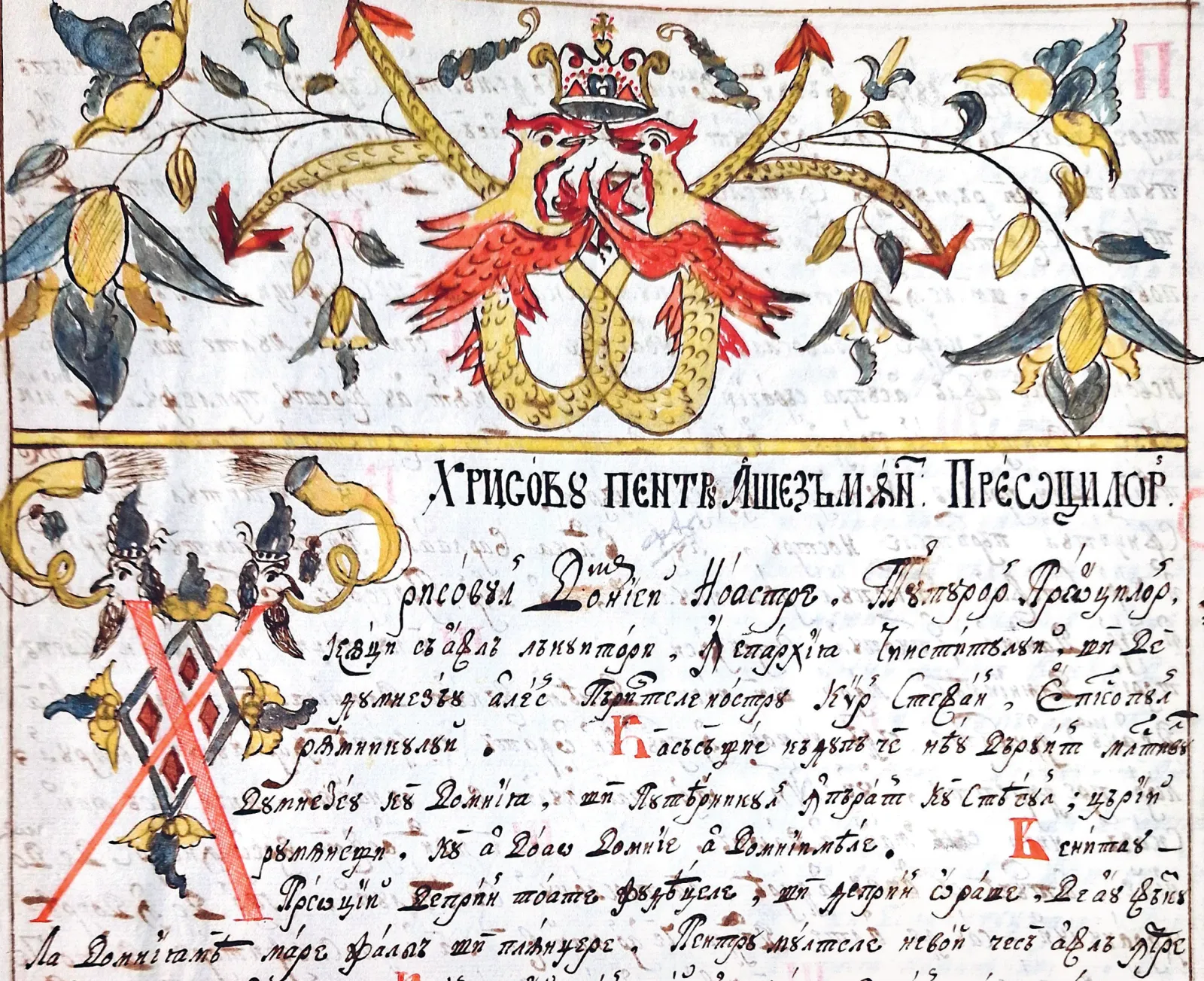
However, we find the decoration of the initial letter particularly interesting; it is rendered by Dionisie the Ecclesiarch in his copy of this document from his register, where he also incorporated the symbolism from the original miniature, with its fantastical elements. And the motif beneath the original text, separating the two parts of the princely monogram, is depicted by Dionisie Ecleziarhul on the frontispiece of his copy, where we see the princely crown supported by two birds and framed by plant and floral motifs. The details indicate that Dionsie produced the transcription in 1786 based on the original document from 1673, even though he did not copy the shape of the birds and the crown exactly, having stylised the floral elements slightly. We also note the presence of birds and some fantastical elements in the miniature of the original document from 1673, issued during the time when Varlaam II (1672–1679) was Metropolitan of Ungrovlahia, as mentioned in the text. However, just a few years earlier, Metropolitan Stephen I (1648–1653, 1655–1668), had served as Metropolitan; it was at his behest that an interesting trilingual Service Book was produced, with the text in Church Slavonic and Greek, but with liturgical instructions in Romanian; a splendidly decorated manuscript, also featuring rare miniatures with zoomorphic and even fantastical motifs, which combine Byzantine influences—visible in the depiction of the icons—with Western models, which favoured zoomorphic or chimeric details.
The 1673 document features an initial letter (copied into the Diocese’s register by Dionisie the Churchwarden in 1786) decorated in a manner atypical of chancery documents. This image, however, is also found in the Service Book ‘95’ by Metropolitan Stephen of Ungrovlahia, as well as in a similar Service Book ‘96’ from the 18th century. Art critics who have studied the miniatures in these manuscripts describe the illustration as follows: ‘Anthropomorphic and vegetal initial. Four heads amidst vegetal elements’97. Although there is no definitive information about the artists who embellished the Arhieraticon, researchers have noted that the style is characteristic of the era of Matei Basarab, who established a new school of miniature painting 98, to which illustrators from other regions—who lived and worked in the Romanian Principalities—also contributed 99. Western bestiaries, such as The Physiologus and The Flower of Gifts 100, also exerted an influence on the miniatures, particularly with regard to the zoomorphic and chimeric images.
It is worth noting that similarities between the miniatures in the manuscripts and those in Wallachian chancery documents from the mid- and second half of the 17thcan also be seen by comparing the type of interlacing in the initial of the 1665 charter with that found in the splendid Slavonic manuscripts 13 101, 651 102 and 29 103, as well as with the initials of the trilingual Service Book from the time of Metropolitan Ștefan, identifiable at the Academy Library under the reference ms. rom. 1790 104. All these liturgical manuscripts date from the mid- and late 17th century and contain images that blend the tradition of Byzantine iconography with Western and Eastern elements, evident in zoomorphic motifs, chimeric forms or specific ‘105’ interlacing patterns, rendered in coloured inks and liquid gold. Indeed, the interlacing patterns on the frontispieces and initial letters of the Wallachian manuscripts 13 and 651, as well as on the chancery document, are common throughout the Balkan region and were also visible in Moldavia during the reign of Vasile Lupu (1634–1653) 106. The dynastic and cultural links between Moldavia and Wallachia at the beginning of the 17th century facilitated the circulation of ornamental patterns between the Romanian principalities. Towards the middle of the same century, art critics highlighted two major styles: that of the Athonite school (where the scriptoria of Mount Athos cultivated a more austere artistic style 107) and that developed in the Romanian Principalities, which derives from the Byzantine tradition (which was not entirely alien to the plant and animal motifs cultivated by the miniaturists who came to the Romanian Principalities 108), but adds Western-style decorations, lending the pieces an air of sumptuousness 109.
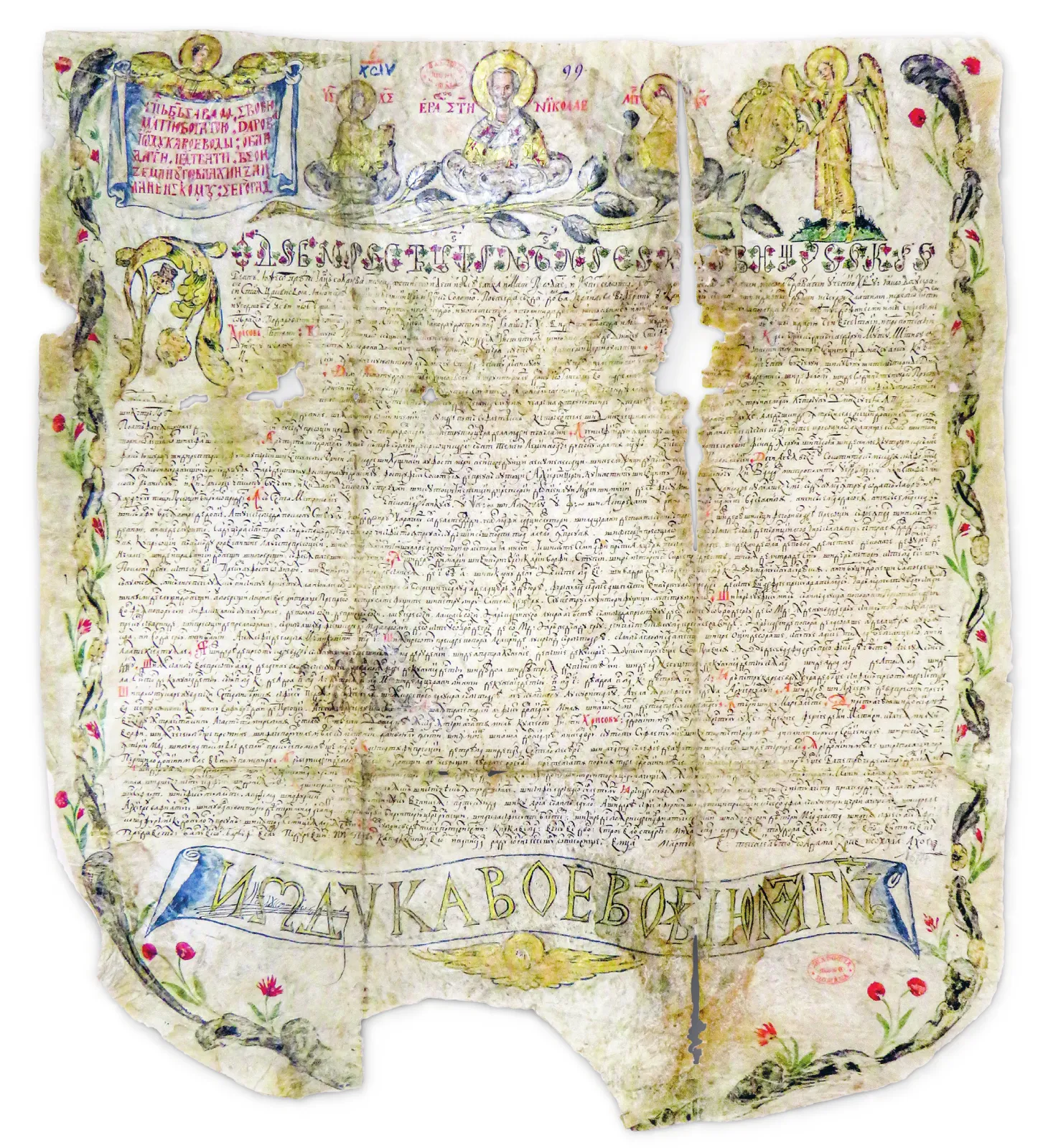
Another charter adorned with images of saints is that of 2 March 1674 110, issued at Târgoviște, whereby Gheorghe Duca 111 determined the tax that each diocese (of the Metropolis of Ungrovlahia, the Dioceses of Râmnic, Buzău and Strehaia) was required to contribute towards the payment of the haraci tax. Written in Romanian on parchment by Radu the scribe, son of Gheorghe the tailor of Târgoviște, the document, now partially damaged in the text section, is adorned on the frontispiece with the image of Saint Nicholas the Hierarch, flanked on either side by the Mother of God (who is handing the saint his omophorion) and Christ the Saviour, with two angels. For the most part, the document reiterated the provisions of the charter dated 15 April 1673, reiterating the priests’ obligation to observe the canons, whilst detailing the financial aspects 112.
Other charters from the 18th century have also been preserved, splendidly illustrated with images of saints, which also come from the collection of Bishop Ghenadie Enăceanu. We refer to the documents dated 30 July 1763 (in which Constantin Racoviță-Cehan confirmed the agreement regarding the salaries of the teachers at the Greek and Slavonic School in Craiova and of the doctor in that town), that of 29 November 1784 (by which Mihail Suțu confirmed the previous grants to the Diocese of Râmnic, the document being adorned with the image of Saint Nicholas the Hierarch, the patron saint of the diocese) and that of 1 July 1787 (in which Nicolae Mavrogheni determined how the water brought by Filaret, Bishop of Râmnic, was to be used at the metochion of the Forty Holy Martyrs in Bucharest, which was decorated with icons of the Holy Martyrs and of Saint Nicholas)113.
Conclusions
1) The documents we have selected highlight, through their content, artistic form and age, the importance of the items from the former library of the hierarch of Râmnic, Ghenadie Enăceanu, which is impressive not so much for the number, quantity and type of materials as for their quality, rarity and even uniqueness, many of which are of undeniable value to national and world history. Bishop Ghenadie’s Historical Documents Collection is extensive, comprising over 1,200 items, and contains a variety of documents. The charters identified and briefly presented in this study (some unpublished, others known only in fragments or as texts, without facsimiles) can be fully utilised through detailed research and studies of a political, socio-economic, cultural-religious and other nature.
2) With regard to the content of the documents, the following range is observed: deeds confirming land ownership granted to private individuals, specifically boyars; confirmations of estates, privileges and tax immunities granted to monasteries or to the Diocese of Râmnic; provisions for the administration of church property, with a view to preventing mismanagement of the estate; documents setting the amount of priests’ dues, as determined by the various dioceses of Wallachia. Although diverse in terms of content, recipients, etc., I have presented them together because they are united by their superb decoration, featuring miniatures in coloured inks and liquid gold. Among the ornamentation, one can observe geometric, floral, plant, zoomorphic and chimeric motifs, as well as borders, frontispieces, vignettes and initials; a distinct category of illustrations consists of those depicting the faces of saints. These are executed in accordance with the norms of Byzantine iconography, unlike the other ornaments, where the miniaturists allowed themselves greater freedom. Indeed, a detailed comparative study of the illuminated manuscripts would be most welcome, in order to compile a record of the copyists and, as far as possible, to attempt to identify the artists, who, in most cases, did not reveal their identities. The practice of not signing works did not imply a lack of ownership of the work, nor superficiality or a tendency to conceal anything, but rather the sense that the work was done for the glory of God, not for personal promotion, which indicates a profound Christian outlook, specific to Orthodoxy.
3) The documents provide us with information about the copyists. In this regard, the details concerning chronology, the rendering of miniatures and the handwriting of the copyists/logophites suggest that the princely scriptoria maintained a certain stability; the scribes did not change with the departure or arrival of another prince, but continued to work ‘114’. The following scribes/logophotes are mentioned: Soare, Goran, Radu, son of Gheorghe Șufar of Târgoviște, Dumitrașco, Isar; all of whom stood out as highly active calligraphers of the time, from whom several documents originate, some featuring interesting ornamentation.
4) The miniatures in the charters open up interesting perspectives. For example, it is evident that, in the mid-17th century, there were similarities between the decoration of religious manuscripts and that of certain chancery documents, whose miniatures featured animal or fantastical motifs. However, whilst the various zoomorphic or floral ornaments on the frontispiece, beneath the text of the charters or within the ‘115’ border served a decorative purpose, highlighting a taste for beauty as well as the craftsmanship of the artists of the time, the images of saints, icons and crosses depicted on chancery documents prove the existence of a Christian state, in which the ruler publicly professed the Orthodox Christian faith. The tradition of Byzantine hermeneia, preserved for the depiction of ‘116’ icons (from charters and manuscripts), is interwoven with Western (Baroque) or Eastern influences in terms of the interlacing patterns, animal and chimeric decorations that appear on some manuscripts and, rarely, on a few chancery documents of the time. However, this style was widespread in manuscripts and printed works throughout the Slavic and Greek worlds, if we consider, for example, the engraving styles in Kyiv prints, such as those from the Kyiv-Pechersk Lavra (some of which are also found in the books of Saint Dosoftei, Metropolitan of Moldavia 117). As art critics have observed 118, even the depictions of animals in religious manuscripts allude to Christian themes (for instance, the pelican’s self-sacrifice). We believe that the personifications of certain virtues depicted on 18th-century Wallachian documents (Justice, Wisdom, Fortitude, etc.) should also be understood in the same light, that is, in their Christian sense. Consequently, the existence of common motifs in the decoration of frontispieces and initial letters in manuscripts from Moldavia, Wallachia and the Greek- or Slavic-speaking Orthodox world (for example, the elaborate interlacing patterns in the Slavonic manuscripts 13, 29, 170, 651 and in the charter of 1665) should come as no surprise, bearing in mind, on the one hand, the cultural and ecclesiastical links between those regions, the unity of the ancient Commonwealth from the Byzantine era to which the historian Dimitri Obolensky referred 119, and, on the other hand, the political and dynastic ties between Moldavia and Wallachia at the beginning of the 17th century.
- 1
The Academy Library was established in 1867, one year after the founding of the Romanian Academic Society. See the recent work History of the Library of the Romanian Academy, vols. 1, 2 (parts 1–3), 3 (parts 1–3), 4 (parts 1–3), edited by Nicolae Noica, Bucharest, Ed. Vremea, 2022–2025.
- 2
We are referring to collections of manuscripts, correspondence, archives, old Romanian books and rare books.
- 3
After 1979, the historical documents were transferred to the National Archives of Romania, and in 2010, they were returned to the Academy Library.
- 4
The documents, dating from the 13th to the 19th centuries, whether originals, historical or modern copies, or translations, may include, by type, chancery documents/deeds, grants, orders, circulars, petitions, decisions of secular or ecclesiastical courts, letters, deeds of sale, exchange agreements, land demarcation deeds, wills, dowry deeds and registers. Issued by private individuals from ecclesiastical or secular circles, by officials, boyars, nobles or sovereigns of Wallachia, Moldavia and Transylvania, as well as of the Habsburg, Tsarist, Ottoman, Poland or certain Western states, the items were handwritten on parchment or paper, with or without a watermark, in Latin, Greek, Church Slavonic, Romanian (using Cyrillic or the Latin alphabet), Turkish, Hungarian, German, etc. For further details, see the series The Treasury of the Romanian Academy, edited by Academician Ionel Haiduc and Academician Păun Ion Otiman, vol. IV, Manuscripts, Historical Documents, Archives and Correspondence, Rare Books, edited by Gabriela Dumitrescu, Bucharest, Published by Romanian Academy, 2013.
- 5
Many items from Bishop Ghenadie Enăceanu’s library were donated to the Academy Library by the Ministry of Religious Affairs and Public Instruction in 1901.
- 6
The year 1835 is mentioned in most articles devoted to this hierarch; see also a recent reprint by Fr Mircea Păcurariu, Dictionary of Romanian Theologians, 3rd ed., Sibiu, Ed. Andreiana, 2014, p. 233.
- 7
Fr. Niculae Șerbănescu, ‘The Hierarchs of the Oltenian Lands in the First Hundred Years of Autocephaly’, in Mitropolia Olteniei, XXXVII, 1985, nos. 5–6, pp. 341–344; Fr. Mircea Păcurariu, Dictionary of Romanian Theologians, 3rd ed., Sibiu, Andreiana Publishers, 2014, pp. 233–234; Bishop Gherasim Cristea, History of the Diocese of Râmnic, Râmnicu-Vâlcea, Conphys, 2009, pp. 220–222; The Rulers and Hierarchs of Wallachia: Their Foundations and Tombs, ed. Fr. Mihai Hau, Bucharest, Cuvântul Vieții, 2009, pp. 1235–1236.
- 8
Prof. T. G. Bulat, ‘A Bishop of Râmnicu Noul Severin and Great Scholar: Ghenadie Enăceanu’, in Mitropolia Olteniei, XVI, 1964, nos. 5–6, pp. 373–386; Florin Marinescu, ‘Bishop Ghenadie Enăceanu’s Love of Books’, in Mitropolia Olteniei, XXVI, 1975, nos. 3–4, pp. 275–279; Octavian-Adrian Negoiță, ‘Under the Guidance of the Muse Clio: Bishop Ghenadie Enăceanu (1835–1898) and His Contribution to Church History’, in *Our Teachers. Our Teachers, ed. I. Moldoveanu, Bucharest, Basilica Publishing, 2020, pp. 25–39.
- 9
Marcel-Dumitru Ciucă, The Auxiliary Sciences of History, Bucharest, University of Bucharest Press, 2008, pp. 84, 87: a removable stamped seal is one in which the seal image is imprinted onto a sheet of paper placed over the hot wax; it was so called because the stamped sheet could be detached from the document, unlike fixed seals, where the wax was placed between the two sheets of the document and the seal impression was applied on top of the first sheet. The hanging seal, attached to the document itself, was also used.
- 10
Marcel-Dumitru Ciucă, The Auxiliary Sciences of History…, p. 103: As part of the final protocol of the diplomatic form, the princely monogram, written beneath the text, was a non-autograph signature, made by the scribe, consisting of the Sign of the Holy Cross, the title ‘Io’, the baptismal name, the title of voivode, the formula of devotion (‘by the grace of God’), and the status of prince; it was rendered in abbreviated form. From the 16th century onwards, the autograph signature was also used.
- 11
Marcel-Dumitru Ciucă, The Auxiliary Sciences of History…, p. 64. Cinnabar was a red-coloured writing fluid used for headings, initials and borders, obtained from mercury sulphide or lead minium (from which the word ‘miniature’ is derived); it was also known as cinnabar.
- 12
Marcel-Dumitru Ciucă, The Auxiliary Sciences of History…, p. 84: The term ‘hrisov’, used in Romania, derives from the Byzantine documents known as ‘hrisobule’, that is, documents authenticated with gold seals.
- 13
BAR, Historical Document, XCIII/38.
- 14
BAR, Historical Document, XCIII/44.
- 15
This refers to Stephen II, Bishop of Râmnic between 1726 and 1727. The Rulers and Hierarchs of Wallachia. Their Foundations and Tombs, edited by Fr. Mihai Hau, Bucharest, Cuvântul Vieții Publishers, 2009, pp. 1201–1202. He was confirmed in office by the Imperial Court in Vienna on 15 October 1716, but was not enthroned until 1727. For this period, see Șerban Papacostea, Oltenia under Austrian Rule (1718–1739), ed. Gheorghe Lazăr, Bucharest, Ed. Enciclopedică, 1998.
- 16
BAR, Historical Document, XCIV/15.
- 17
BAR, Historical Document, XC/5.
- 18
BAR, Historical Document, XCIV/58.
- 19
‘Vinărici’ was the name given to the tax levied on vineyards and wine. For details regarding the amount of this tax, the method of payment and its history, see Feudal Institutions in the Romanian Principalities. Dictionary, ed. Ovid Sachelarie and Nicolae Stoicescu, Bucharest, Editura Academiei, 1988, pp. 501–502.
- 20
‘Goștina’, a term of Slavic origin, referred to a levy levied on sheep and pigs. Feudal Institutions in the Romanian Principalities. Dictionary..., pp. 208–209.
- 21
BAR, Historical Document, XC/241.
- 22
BAR, Historical Document, XC/203.
- 23
BAR, Historical Document, XCI/1.
- 24
Feudal institutions in the Romanian Principalities. Dictionary, ed. Ovid Sachelarie and Nicolae Stoicescu, Bucharest, Editura Academiei, 1988, p. 434: the serdar, attested in Moldavia and Wallachia, had primarily military duties, supplemented by other responsibilities.
- 25
BAR, Historical Document, XCIII/10.
- 26
BAR, Historical Document, XCIII/323.
- 27
BAR, Historical Document, XC/96.
- 28
Ștefan Ștefănescu, The History of the Romanians from Mihai Viteazul to Constantin Brâncoveanu, Bucharest, University of Bucharest Press, 1996; Ion I. Croitoru, Orthodoxy and the West in the Spiritual Tradition of the Romanians. The Unity of Orthodoxy and the Defence of the Orthodox Faith against Protestant Propaganda in the 17th Century, vol. I, Târgoviște, Cetatea de Scaun Press, 2012, pp. 98–120 (Chapter: The Political Situation of the Romanian Principalities in the 17th Century).
- 29
Ștefan Ștefănescu, ‘The Long War’ (1593–1606) and the Romanian Resurgence, in The History of the Romanians, vol. IV, ed. Ștefan Ștefănescu, Bucharest, Ed. Enciclopedică, 2001, pp. 593–640.
- 30
See Șarolta Solcan, 17th-Century Romanian Society as Reflected in Hungarian-Language Sources, Bucharest, University of Bucharest Press, 2000, pp. 167–168; Ștefan Andreescu, Restitutio Daciae, vol. II, Bucharest, Albastros, 1989, pp. 85–134.
- 31
Florin Constantiniu, An Honest History of the Romanian People, 4th ed., Bucharest, Ed. Enciclopedic Gold, 2010, p. 150 (see the entire chapter: ‘The Romanian Principalities and the Decline of Ottoman Power’, pp. 145–173).
- 32
Constantin Rezachevici, ‘The Conflict between the Cantacuzino and Leurden Factions’, in The History of the Romanians, vol. V, An Era of Renewal in the European Spirit (1601–1711/1716), ed. Virgil Cândea, Bucharest, Ed. Enciclopedică, 2003, pp. 210–223; see also Constantin C. Giurescu, The History of the Romanians, vol. III, part one, Bucharest, Royal Foundation for Literature and Art, 1942, pp. 107–128 (chapter ‘The Descendants of Matei Basarab up to Șerban Cantcuzino<!-- sic -->’).
- 33
Constantin Rezachevici, ‘Political Life in the Mid-17th Century: The Era of Matei Basarab, Vasile Lupu and the Racocze family’, in The History of the Romanians, vol. V…, pp. 105–175.
- 34
Constantin Rezachevici, ‘The International Situation: Euro-Asian Social and Political-Military Developments. Interaction with the Romanian Sphere’, in The History of the Romanians, vol. V…., pp. 3–32.
- 35
Constantin Bălan, ‘The Church in Wallachia and Moldavia’, in The History of the Romanians, vol. V, An Era of Renewal in the European Spirit (1601–1711/1716), ed. Virgil Cândea, Bucharest, Ed. Enciclopedică, 2003, pp. 744–770.
- 36
See Associate Professor Dr (now Professor Dr habil.) Ion Marian Croitoru, Saint Antim Ivireanul – Defender of the Ancestral Law, Râmnicu Vâlcea, Praxis Publishing House of the Archdiocese of Râmnic, 2019; Ion I. Croitoru, Orthodoxy and the West in the Spiritual Tradition of the Romanians. The Unity of Orthodoxy and the Defence of the Orthodox Faith against Protestant Propaganda in the 17th Century, vols. I–II, Târgoviște, Cetatea de Scaun Publishing House, 2012.
- 37
BAR, CRV 117, 46, 68. To name but a few of these, we recall: Orthodoxos omologia / The Confession of the Orthodox Faith, a work by Metropolitan Petru Movilă, printed at Snagov in 1699 by Saint Antim of Ivire (CRV 117); The Instructive Gospel, published at Dealu Monastery in 1644 (CRV 46); and The Key to Understanding by Ioanichie Galeatovski, published by the Metropolitanate of Bucharest in 1678 (CRV 68).
- 38
Matei Basarab was Prince of Wallachia from 1632 to 1654. The History of the Romanians, vol. V, An Era of Renewal in the European Spirit (1601–1711/1716), ed. Virgil Cândea, Bucharest, Ed. Enciclopedică, 2003, p. 1031.
- 39
BAR, Seal 186.
- 40
Feudal Institutions in the Romanian Principalities. Dictionary..., p. 130: cupar – a secondary official, similar to the cupbearer.
- 41
Sărăcinești – a village in Vâlcea County, now part of the commune of Păușești Măglași. Melentina Bâzgan, Index of Medieval Settlements in Wallachia up to 1831, Bucharest, Cartea Universitară, 2004, p. 89.
- 42
Mihăiești – a village in Vâlcea County. Melentina Bâzgan, Index of Medieval Settlements in Wallachia up to 1831..., p. 65.
- 43
Păușești – a village in Vâlcea County, now part of the commune of Păușești-Măglași. Melentina Bâzgan, Index of Medieval Settlements in Wallachia up to 1831..., p. 75.
- 44
Bunești – a village in Vâlcea County. Melentina Bâzgan, Index of Medieval Settlements in Wallachia up to 1831..., p. 25.
- 45
Viespari – a village in Teleorman County. Melentina Bâzgan, A Guide to Medieval Settlements in Wallachia up to 1831..., 2004, p. 108.
- 46
Documenta Romaniae Historica (DRH), B, Wallachia, XXVIII (1641–1642), ed. Oana Rizescu, Bucharest, Romanian Academy Press, 2018, doc. 84, pp. 134–135.
- 47
Feudal institutions in the Romanian Principalities. Dictionary, ed. Ovid Sachelarie and Nicolae Stoicescu, Bucharest, Academy Press, 1988, p. 167: Dominium eminens is the right of the prince (sovereign) to rule over the entire landholding of the country.
- 48
Feudal Institutions in the Romanian Principalities. Dictionary..., p. 246: Members of village communities regarded one another as brothers, that is, as descendants of the same ancestor; this ‘brotherhood’ brought into the community, in the guise of a brother, a relative or a stranger, so that they might immediately share in the communal use of the land and remain an heir upon the death of the person with whom they had formed this bond. Fraternity is attested in documents from Wallachia during the reign of Vlad Dracul. In Moldavia, brotherhood is not attested in documents, as there daughters, inheriting their parents’ estates with rights equal to those of their sons, meant that the main reason for this institution ceased to exist … two or more persons agreed, by means of a deed drawn up before the competent authorities, to jointly hold, in the future, the estates and their shares of the estates specified in that deed, stipulating that, in the event of the death of one of the parties without legitimate heirs, that those estates or shares should pass – by virtue of the right of fraternity (ius fraternale) – to the surviving party or parties amongst the contracting parties or to their descendants.
- 49
See Valentin Al. Georgescu, Pre-emption in the History of Romanian Law, Bucharest, 1965; Valentin Al. Georgescu, Byzantium and Romanian Institutions up to the Mid-18th Century, Bucharest, Ed. Academiei, 1980.
- 50
For further details, see Gheorghe Cronț, Medieval Romanian Institutions: The Twinning of Estates. The Jurors, Bucharest, 1969. The right of pre-emption was effective, for, if it was not respected, a sale could be annulled, as we read in numerous historical documents.
- 51
DRH, B, Wallachia, XXVIII (1641–1642)…, p. 135.
- 52
Forms of remuneration for military service had, of course, been recorded in previous centuries—albeit under different names and with specific characteristics—both in the medieval Western world (fief) and in the Byzantine world<!-- sic --> (pronoia), in South-Eastern Europe (beneficium) or in the Ottoman Empire (timar). See Valeria Costăchel, ‘The Beneficium in South-Eastern Europe’, in Revista istorică, XXX, 1944, pp. 61–86; on the specific nature of the timar and its difference from the Western model, see Halil Inalcik, The Ottoman Empire. The Classical Age, 1300–1600, ed. Mihai Maxim, Bucharest, Ed. Enciclopedică, 1996, pp. 216–217: for the Byzantine pronoia, see Peter Schreiner, ‘The Soldier’, in The Byzantine Man*, ed. Guglielmo Cavallo, trans. Ion Mircea, Iași, Polirom, 2000, p. 97 (the entire study appears on pp. 87–110); Stelian Brezeanu, A History of Byzantium, Bucharest, Meronia, 2004, p. 347: pronoia is a life annuity, conditional upon the beneficiary fulfilling certain obligations towards the state, in the vast majority of cases of a military nature. The emperor thus ceded to the pronoiar the total sum of the taxes payable by the peasants on a specific area of land.
- 53
Marcel-Dumitru Ciucă, The Auxiliary Sciences of History…, p. 85: The seal was attached to the document by means of a fold, which involved folding the lower part of the parchment upwards to prevent the document from tearing under the weight of the suspended seal; the cord was tied in the shape of a cross.
- 54
Grigorie I Ghica was Prince of Wallachia from 1660 to 1664 and from 1672 to 1673. The History of the Romanians, vol. V, An Era of Renewal in the European Spirit (1601–1711/1716), ed. Virgil Cândea, Bucharest, Ed. Enciclopedică, 2003, p. 1032.
- 55
The Rulers and Hierarchs of Wallachia. Their Foundations and Tombs, ed. Fr. Mihai Hau, Bucharest, Cuvântul Vieții Publishers, 2009, pp. 512–514.
- 56
These provisions were also reiterated in other royal decrees, dating from the reigns of Mircea the Elder, Leon Vodă and Matei Basarab, and were upheld by church leaders, including Patriarch Eftimie and Metropolitan Luca, who are mentioned in the text of 1664.
- 57
Gheorghe Buluță, Sultana Craia, Illuminated and Decorated Manuscripts from the Time of Matei Basarab, Bucharest, Meridiane Publishers, 1984, pp. XI, XIV.
- 58
Traian Ionescu-Nișcov, Maria Soveja, Documents from the Princely Chancellery: Ornaments and Miniatures, Bucharest, Meridiane Publishers, 1974; VII – Document issued by Matei Basarab, 17 July 1636 (ANIC, Seal Collection, 49) – a bird appears above the initial, which is adorned with floral motifs and coloured with vivid inks (orange, yellow, green, blue).
- 59
ANIC (Central National Historical Archives), Metropolitanate of Wallachia, CXXXI/11; Gheorghe Buluță, Sultana Craia, Illuminated and decorated manuscripts from the era of Matei Basarab..., XXXV, d.
- 60
Stephen I, Metropolitan of Ungrovlahia from 1648 to 1653 and from 1656 to 1668. See The Rulers and Hierarchs of Wallachia: Their Foundations and Tombs, edited by Fr. Mihai Hau, Bucharest, Cuvântul Vieții Publishing House, 2009, p. 508.
- 61
Ignatie the Greek, Bishop of Râmnic between 1567 and 1668. See The Rulers and Hierarchs of Wallachia. Their Foundations and Tombs..., p. 1189.
- 62
Serafim, Bishop of Buzău from 1648 to 1668. The Rulers and Hierarchs of Wallachia. Their Foundations and Tombs..., p. 874.
- 63a63b63c
BAR, Historical Document, XCIV/1.
- 64
Eftimie, Metropolitan of Ungrovlahia from 1595 to 1602. The Rulers and Hierarchs of Wallachia. Their Endowments and Tombs..., p. 506. He convened the synod at Târgoviște.
- 65
Teofil, Bishop of Râmnic between 1594 and 1601. The rulers and hierarchs of Wallachia. Their charitable endowments and tombs..., p. 1186.
- 66
Luca, Bishop of Buzău from 1583 to 1602. The Rulers and Hierarchs of Wallachia. Their Foundations and Tombs..., p. 870. Mihai Viteazul’s charter was issued on 13 April 1596. Published, in translation, in Documenta Romaniae Historica (DRH), B, Wallachia, vol. XI (1593–1600), ed. Damaschin Mioc, Ștefan Ștefănescu, Bucharest, Ed. Academiei, 1975, pp. 205–206, doc. 160.
- 67
BAR, Historical Document, XCIV/1: The abbot must be a priest who is capable of celebrating the Holy Liturgy and of managing the affairs of the monastery; the council must take into account the abbot’s income and expenditure, and no one else was to take charge of them. And if there were no priest in the monasteries to serve as abbot, then again, with the consent and advice of the council, they were to bring in from another monastery whomever they deemed fit.
- 68
Oana-Mădălina Popescu, ‘Legislative Acts Concerning Church Life in Wallachia in the 17th Century’, in Martyria, 2017, no. 2, pp. 37–58.
- 69
Radu Leon was Prince of Wallachia from 1664 to 1669. The History of the Romanians, vol. V, An Era of Renewal in the European Spirit (1601–1711/1716), ed. Virgil Cândea, Bucharest, Ed. Enciclopedică, 2003, p. 217.
- 70a70b
BAR, Seal 187.
- 71
corrections in the text.
- 72a72b
Ibid.
- 73
Feudal Institutions in the Romanian Principalities. Dictionary, ed. Ovid Sachelarie and Nicolae Stoicescu, Bucharest, Editura Academiei, 1988, pp. 444–445.
- 74
Feudal Institutions in the Romanian Principalities. Dictionary…, pp. 158–159: a levy of one-tenth of the produce paid to the prince, boyars and monasteries, levied on various products. It was linked to the prince’s right of domnium eminens.
- 75
Feudal Institutions in the Romanian Principalities. Dictionary…, p. 207. Penalties could be redeemed by paying a fine in the form of a horse. The last recorded instance of this practice in Moldavia, Wallachia and Transylvania dates from the 18th century.
- 76
Constantin Rezachevici, ‘The Conflict between the Cantacuzino and Leurden Factions’, in The History of the Romanians, vol. V, An Era of Renewal in the European Spirit (1601–1711/1716), ed. Virgil Cândea, Bucharest, Ed. Enciclopedică, 2003, p. 217: By appointing a prince who was not aligned with either of the boyar factions, the Sublime Porte sought to provide an arbitrator around whom members of both factions might rally. The plan did not work.
- 77
BAR, Historical Document XCIV/2. Written in Romanian by the same Dumitrașco, the logothete, on beautifully decorated parchment, in a style not identical to, but somewhat similar to, that of Radu Leon’s document. The initial letter of the 1664 document was also framed and adorned with plant motifs, albeit in slightly lighter shades. Flowers also appear on the frontispiece, symmetrically placed on either side of the coat of arms. Larger and smaller crosses are rendered in gold leaf at the top of the charter, immediately after the prince’s name and the title/formula of devotion, as well as beneath the text, before the prince’s monogram, and also within some of its letters.
- 78
BAR, Historical Document, XCIV/5. Radu Leon exempted the villagers of Muereasca from taxes, setting only a fixed sum for them compared with other taxpayers, as they were of assistance to the Holy Diocese. It was recalled that Bishop Serafim of Râmnic had come before the prince, stating that the inhabitants were being treated unjustly and overburdened by the prince’s officials, who were demanding additional taxes beyond those already set, which was why they had begun to flee, to the detriment of the bishopric. The text is written on paper by Goran the scribe, and the miniatures, though<!-- sic --> beautiful and delicate, appear less elaborate than in previous instances. The sign of the Holy Cross and the initial letter are adorned with flowers, without a border; the upper part of the document has no decoration or coat of arms, and a stamped seal, which has since fallen off, was used as a mark of validation. The princely monogram beneath the text had fewer embellishments and was written in cinnabar rather than liquid gold; consequently, in terms of form, this document exhibits a lesser degree of splendour compared to those presented previously.
- 79
For more on the work of this scribe, who produced both chancery documents and manuscripts, see Violeta Barbu, ‘The Brâncoveanu Scribes: The Metropolitan See of Ungrovlahia and the Princely Chancellery, in ‘Ars Transilvaniae’, I, 1991, p. 43.
- 80
Ilarion II, Bishop of Râmnic between 1693 and 1705.
- 81a81b
BAR, Historical Document, XCIV/12.
- 82
Feudal Institutions in the Romanian Principalities. Dictionary, ed. Ovid Sachelarie, Nicolae Stoicescu, Bucharest, Ed. Academiei 1988, p. 417: the original meaning is that of a bargain or agreement; over time, it came to denote a specific function within the fiscal system: a single, lump-sum payment, agreed by mutual consent with the ruling authority; paid in four quarterly or half-yearly instalments.
- 83
Feudal institutions in the Romanian Principalities. Dictionary, ed. Ovid Sachelarie, Nicolae Stoicescu, Bucharest, Academy Press 1988, p. 483: ughi – a Hungarian gold coin, modelled on the florin (ducat); it appeared under various names and circulated in the Romanian Principalities, having a more stable value compared to other types of currency; during the reign of Constantin Brâncoveanu it was worth 1.50 thalers.
- 84
ANIC, Metropolitanate of Wallachia, CDXCIV/2, document dated 16 July 1698. See Claudiu Victor Turcitu, Constantin Basarab Brâncoveanu. A Prince’s Portrait and a Retrospective on an Era (1654–1714), Bucharest, DAR Development Publishing, 2019, pp. 276–277.
- 85
Oana-Mădălina Popescu, ‘God is marvellous in His saints. Holy images in ancient Romanian manuscripts’, 2nd ed., Bucharest, Dinasty Books Publishing House and Printing Works, 2021.
- 86
In this regard, see Mihai Maxim, ‘The Romanian Principalities and the Ottoman Empire’, in The History of the Romanians, vol. V, An Era of Renewal in the European Spirit (1601–1711/1716), ed. Virgil Cândea, Bucharest, Ed. Enciclopedică, 2003, pp. 803–852; Mihai Maxim, The Romanian Principalities and the Sublime Porte. The Legal Framework of Romanian-Ottoman Relations in the Middle Ages, Bucharest, 1993; Ion I. Croitoru, Orthodoxy and the West in the Spiritual Tradition of the Romanians. The Unity of Orthodoxy and the Defence of the Orthodox Faith against Protestant Propaganda in the 17th Century, vol. I, Târgoviște, Cetatea de Scaun Publishing House, 2012, pp. 85–120 (Chapter: The Romanian Principalities on the Frontiers between the West and Islam. The Historical and Political Conditions of these Principalities in the 17th Century).
- 87
See Oana-Mădălina Popescu, ‘God is marvellous in His Saints: Holy Images in Ancient Romanian Manuscripts’, 2nd ed. …, pp. 479, 483.
- 88
BAR, Historical Document, XCIV/8.
- 89
He is believed to be the same person as Daniil Andrean, who translated The Rectification of the Law; he was the sole hierarch of the Diocese of Strehaia, established in 1672 by Grigorie I Ghica with limited jurisdiction, in the Mehedinți area, but abolished in 1679 by Șerban Cantacuzino, who transferred Daniil to serve as abbot of Cotroceni Monastery. See Fr. Niculae Șerbănescu, ‘New Evidence on the Diocese of Strehaia and its Bishop, Daniil’, in Mitropolia Olteniei, 1961, nos. 1–2, p. 76; Fr. Mircea Păcurariu, History of the Romanian Orthodox Church, vol. 2, Bucharest, Published by the Biblical and Missionary Institute of the Romanian Orthodox Church, 1992, pp. 165–166.
- 90
BAR, Historical Documents, CMLXXV/1. The register previously had a manuscript reference number, namely 2082; currently, copies of the 326 deeds are listed as historical documents (Historical Documents, CMLXXV/1–326).
- 91
BAR, Historical Document, CMLXXV/1.
- 92
BAR, Historical Document, XCIV/5.
- 93
These relate to the right of foundation.
- 94
BAR, Ms. sl. 651, f. 1v, a portrait of Matei Basarab and Elina, depicted in the Slavonic Liturgy Book of 1653–1654, written and illuminated by Radu Sârbul; see also Gheorghe Buluță, Sultana Craia, Illuminated and Ornate Manuscripts from the Era of Matei Basarab, Bucharest, Meridiane Publishers, 1984, III, the portrait of Lady Elina, in the Gospel Book of 1642–1643 from the Patriarchal Library in Jerusalem; the portrait of Matei Basarab and his wife, Elina, in the Gospel Book dated circa 1650, held at the National Library in Paris.
- 95
BAR, Romanian manuscript 1790, fol. 77v.
- 96
BAR, Ms. rom. 1384, f. 70v.
- 97
Ileana Stănculescu, A Study of the Illustrations in Ms. Rom. 1790 BAR, in the Liturgical Book of Metropolitan Stephen of Ungrovlahia. Ms. Rom. 1790 from the Library of the Romanian Academy, Bucharest, vol. II, ed. Ileana Stănculescu, Bucharest, Basilica Press, 2021, p. 151 (the entire study, pp. 93–186); see also The Archiepiscopal Service Book of Metropolitan Stephen of Ungrovlahia. Western Realism in 17th-Century Romanian Miniature Art, facsimile edition based on the Romanian manuscript 1790 held at the Library of the Romanian Academy, Bucharest, Sapientia Principium Cognitio, 2017, f. 77.
- 98
Gheorghe Popescu-Vâlcea, The Clerk of Metropolitan Ștefan of Ungrovlahia (1648–1688), Bucharest, Meridiane Publishers, 1974, p. 10.
- 99
Ileana Stănculescu, ‘A Study of the Illustrations in Ms. Rom. 1790’, in Trilingual Manuscript: Preliminaries to an Edition, ed. Ileana Stănculescu, Bucharest, Paideia, 2010, p. 125: the analysis of the miniatures in Ms. Rom. 1790 should be considered in parallel with the work carried out in Muntenia by various foreign miniaturists, particularly those invited by the princes of Muntenia. Constantin the Croatian, Matei the Calligrapher (who had come from Epirus), Luca, who went on to become Bishop of Buzău, and Porfirie are figures who introduced into Romanian miniature painting formal floral and zoomorphic stylisations of a distinctly Eastern nature, as well as graphic elements characteristic of the engraving techniques used in the printed books of the time. Overlaying this iconographic background are the influences of European artistic movements from the late 16th and 17th centuries (the Renaissance and the Baroque), visible particularly in the design of the frontispieces and the full-page depictions of standing figures; See also Gheorghe Popescu-Vâlcea, Romanian Miniatures. Miniatures and Ornaments in Romanian Manuscripts, trans. Andrei Bantaș, Bucharest, Meridiane, 1998, p. 50.
- 100
The Archiepiscopal Servant of Metropolitan Ștefan of Ungrovlahia. Western Realism in 17th-Century Romanian Miniatures, facsimile edition based on the 1790 Romanian manuscript held at the Library of the Romanian Academy..., p. 248; see also Cătălina Velculescu, Proloage, Fiziolog, Alexandria, Cosmografi, Piscu, Agatonia School, 2018, p. 165; Cătălina Velculescu, Ileana Stănculescu, Not by the Letter, but by the Spirit and the Mystery of Thought, Piscu, Școala Agatonia, 2020, p. 143.
- 101
A Brief Introduction to the Art of Miniature Painting: Exhibition Catalogue, ed. Gabriela Dumitrescu, Bucharest, Tracus Arte, 2009, p. 62: A Tetraevangelion commissioned by Matei Basarab in 1643 for Căldărușani Monastery; copied by the monk Mardarie and illuminated by the priest Vlaicu the Painter, who signed his name on the image of Saint Luke the Apostle.
- 102
A Brief Introduction to the Art of Miniature Painting: Exhibition Catalogue..., p. 72: A liturgical book written between 1653 and 1654.
- 103
Petre P. Panaitescu, Slavic Manuscripts in the Academy Library, vol. I, Bucharest, Academy Press, 1959, p. 44: Liturgy book, 17th century.
- 104
The valuable 1790 manuscript by Metropolitan Ștefan, which was donated to the Academy Library by the Ministry of Religious Affairs and Public Instruction on 21 May 1901, bears the following note on the first folio: This book is donated by the undersigned to the Library of the Central Seminary in Bucharest, 25 February 1869. Ghenadie, Archdeacon of the Metropolis. Comparing the handwriting of this note with an autograph letter by Bishop Ghenadie Enăceanu, we find that the handwriting is remarkably similar; so it cannot be ruled out that the Service Book may also have belonged to the future hierarch of Râmnic, who was then, in 1869, a deacon, and who donated it to the Central Seminary, where he served as a teacher; however, this hypothesis remains to be confirmed.
- 105
We also see similar interlacing on the frontispiece of a manuscript produced by Arsenius in the first half of the 17th century, who was to become the abbot of Varlaam Monastery in Greece and who had been a pupil of the calligrapher Matei al Mirelor; Arsenie worked in Wallachia during the reign of Matei Basarab. The image is reproduced in the work on the Greek Liturgy Book from Stavropoleos Monastery, with an introductory study by Ovidiu-Victor Olar, Bucharest, Ed. Cuvântul Vieții, 2024, p. 29, fig. 10 c.
- 106
For example, a Missal from 1643, copied and probably illuminated by Ivanco of Rădăuți, an item also held in the collections of the Romanian Academy Library in Bucharest. A Brief Introduction to the Art of Miniature Painting: Exhibition Catalogue..., pp. 68, 72. This refers to Ms. sl. 170.
- 107
Gheorghe Buluță, Sultana Craia, Illuminated and Ornate Manuscripts from the Era of Matei Basarab, Bucharest, Meridiane Publishers, 1984, p. 9.
- 108
Gheorghe Popescu-Vâlcea, Romanian Miniatures: Miniatures and Ornaments in Romanian Manuscripts, trans. Andrei Bantaș, Bucharest, Meridiane, 1998, pp. 50–52.
- 109
Gheorghe Buluță, Sultana Craia, Illuminated and Ornate Manuscripts from the Time of Matei Basarab, Bucharest, Meridiane Publishers, 1984, p. 9.
- 110
BAR, Historical Documents, XCIV/6; see also Oana-Mădălina Popescu, ‘God is Wonderful in His Saints: Holy Images in Ancient Romanian Documents’, 2nd ed., … p. 484.
- 111
Gheorghe Duca was Prince of Wallachia from 1673 to 1678. The History of the Romanians, vol. V, An Era of Renewal in the European Spirit (1601–1711/1716), ed. Virgil Cândea, Bucharest, Ed. Enciclopedică, 2003, p. 1033.
- 112
BAR, Historical Document, XCIV/6: The Metropolis and Diocese of Râmnic each paid 750 ughi, the Diocese of Buzău 500, and Strehaia 150.
- 113
For further details, see Oana-Mădălina Popescu, ‘God is Wonderful in His Saints: Holy Images in Ancient Romanian Manuscripts’, 2nd ed., pp. 570, 616, 621.
- 114
Certain characteristics specific to a particular school were also beginning to emerge, as we have seen in the case of the apprentices of the calligraphers Matei of Mirelo and Luca of Buzău.
- 115
Oana-Mădălina Popescu, ‘Documents Embellished with Floral Miniatures’, in Tezaur. Journal of the Romanian Academy Library, vol. VI, July 2025, no. 7, pp. 8–9.
- 116
Unfortunately, certain changes from the Byzantine style are evident in the way icons were painted (and thus also in those found in the miniatures of charters and manuscripts, and in the engravings of printed works) from the 16th century onwards, first in the Balkan and Greek worlds, against the backdrop of the Ottoman occupation and Western influence in the region—intensified by the conquest of certain islands—and subsequently transmitted to the Slavic and Romanian worlds. In the Orthodox world, however, these artistic innovations circulated merely as a fashion, although in the West they had underpinned doctrinal innovations. Constantine Cavarnos, A Guide to Byzantine Iconography, trans. Anca Popescu, ed. Ștefan Ionescu-Berechet, Bucharest, Sophia Publishing, 2005, pp. 163–164. For example, the icon of the Holy Trinity, in which God the Father is depicted as an old man, appeared in the West to support the Filioque heresy. Western missionaries also brought with them engravings featuring modernist Western religious motifs. Iconography in Russia was also affected.
- 117
Cornel Tatai-Baltă, Anca Elisabeta Tatay, ‘Graphic Art in Dosoftei’s Book, Molităvnic de-nțeles, Iași, 1681’, in Metropolitan Dosoftei, Molităvnic de-nțăles, Iași, 1681, ed. Mădălina Ungureanu, Published by Al. Ioan Cuza University of Iași, Published by Metropolitan Iacov Putneanul, Iași, Putna Monastery, 2024, pp. 50–70.
- 118
Gheorghe Popescu-Vâlcea, Romanian Miniatures. Miniatures and Ornaments in Romanian Manuscripts, trans. Andrei Bantaș, Bucharest, Meridiane, 1998, p. 53: For the most part, the images in Metropolitan Ștefan’s Service Book can be interpreted as symbols of moral or religious ideas, drawn from the works Physiologus and The Flower of Gifts.
- 119
Dimitri Obolensky, A Medieval Commonwealth: Byzantium, Bucharest, Corint Publishers, 2002.