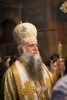
The most prominent figure, both in spiritual and cultural terms and in administrative – municipal or pastoral-missionary – matters, in the Archdiocese of Râmnic remains, to this day, that of Saint Calinic of Cernica, Bishop of Râmnic, on whose passing into the unending Kingdom of God we mark a century and a half this year.
A monk of exceptional vocation, brought up in the monastic spirit of the holy abbots Paisie Velicicovski and Gheorghe of Cernica and Căldărușani, Saint Calinic, both during his time as abbot of the Cernica Lavra and as Bishop of Râmnic–Noul Severin, proved to be a caring mentor and guide to monks and priests. His work in the historic diocese of Râmnic unfolded on multiple levels, with the continuation of Paisian spirituality as its fundamental guiding principle. His entire activity constituted a well-structured programme, carried out with great diligence, aimed at achieving his sacred goal: the spiritual renewal and cultural revival of the diocese which, by God’s providence, he shepherded.
Saint Calinic succeeded in renewing the spiritual life of the renowned monastery founded by the great vornic Știrbei Cernica, of which he was abbot from 1818 to 1850, closely linking it to Philokalic spirituality, which he spread throughout Wallachia through the monasteries he founded or which were governed according to his rules.
His concern for the spiritual life, for the inner life, did not prevent him from engaging in an equally rich range of external activities, in both the cultural and administrative spheres: at his own expense, he established a printing press in Râmnic, where he printed numerous books on doctrine and prayer; he founded a number of monasteries, the Diocesan Centre and the Archiepiscopal Cathedral in Râmnic; he reorganised the Seminary and established several schools. Nevertheless, he never ceased to live a life of humility and simplicity: ‘From the year 1850, when he was elected bishop, until the year 1868, when he passed away, he did not in any way neglect his monastic duties but, on the contrary, strove all the more in every good deed; even the robes he wore as bishop were no finer than those he wore when he was abbot at Cernica Monastery’1’ Perhaps even more so than Saint Paisius Velichkovsky, he succeeded in balancing practical life with the life of prayer in the monasteries within his order.
He understood admirably that, in order to achieve this aim, the spiritual edification of the faithful requires prayer, monks who lead a life of prayer, and monasteries that offer those who come to them examples of an angelic way of life: ‘He wished for the way of life of the inhabitants of our monasteries to be a truly worthy example to follow. To this end, perhaps even from the very beginning of his abbotship at Cernica, he drew up a series of Guidelines for monks, intended ‘to raise the spiritual level of the Cernica community’ and, at the same time, revealing the ‘monastic ideal’ of their author’2 The community of Cernica Monastery was governed by this monastic rule throughout the 32 years of his abbacy, as was Frăsinei Monastery 3.
His longing for the hermit’s life led him to establish at Frăsinei a community eager to lead a life of solitude, according to the rule of the Fathers of Mount Athos, established there by the holy founder4.
He would often extend his period of fasting to forty days. Throughout his entire life as a monk, he never ate meat, and from 1820 onwards he even abstained from fish, consuming only vegetables. ‘In order to overcome pride, only on Saturdays would he eat a little egg, cheese and milk’5. As for sleep, ‘at night he slept no more than three hours, and not on a bed, but on a chair’6. All the monks, both old and young, admired and loved him with a pure heart because he was truly humble, without pretence, hatred or cunning, submitting to everyone 7.
The Life of Saint Calinic of Cernica reveals the charisms specific to this holy abbot: the gift of the prayer of the heart (he was renowned as a guide to the prayer of the heart), the gift of leading large communities, and also that of working miracles, even during his lifetime.
The Life of Saint Calinic of Cernica reveals the specific charisms of this holy abbot: the gift of prayer of the heart (he was renowned as a guide to the prayer of the heart), the gift of leading large communities, and also that of performing miracles even during his lifetime.
Saint Calinic urged the monks to keep the Jesus Prayer constantly on their lips, in their minds and in their hearts. Saint Calinic not only founded monasteries and communities, but also bequeathed to them—and through them to us today—rules to guide us towards attaining the Kingdom of Heaven.
In 1847, the great fire took place which consumed most of Râmnic: the Bishop’s Palace, the Seminary, the primary school, as well as a great many houses in the central area – in other words, over half of what constituted Râmnicu Vâlcea at that time. The man who began the work of rebuilding the town was Saint Calinic of Cernica, elected Bishop of Râmnic in 1850.
The Bishop’s Palace and the Seminary were the first buildings rebuilt by Saint Calinic, as the tragedy of the fire led to the town’s long-overdue modernisation. The first priority was the widening and modernisation of Ulița Mare, now known as Calea lui Traian. River stone paving and the light from street lamps – initially fuelled by large candles and later by paraffin – bathed Râmnicu-Vâlcea in a light it had never known before.
If we speak today of the development of the town of Râmnicu-Vâlcea, this is, without any exaggeration, due to the local Church, which not only managed to double the town’s economic activity but also to sustain it directly and to stimulate the spiritual, cultural and economic development of the municipality of Râmnicu-Vâlcea. The 19th-century paper mills and printing works, which caused the town to flourish – where did they find their source, if not in Saint Calinic’s personal donation to the Râmnic town council?
As for his passing, it was just as marvellous as his life 8. He foresaw his death thirteen days in advance: ‘When those days were over, he became completely well, rose, and dressed in his burial clothes, for he had given all his other possessions as alms, he washed his own face, combed his hair and blessed all of us who were in the house. And as he stood there, he leaned against the chest of the monk Gherman, saying: ‘Let us meet again in the bliss of the next world’ and, breathing three times from his holy lips, he remained leaning against Father Gherman’s chest”9
Saint Calinic’s contribution to the flourishing of the town of Râmnicu-Vâlcea was overwhelming; the diocese he led was renewed in every respect, but especially spiritually, this making him the most important figure in Râmnic, a fact recognised by the Holy Synod of the Romanian Orthodox Church at its working session in October 1955, when his canonisation was approved.
- 1
Archimandrite Anastasie BALDOVIN, ‘The Life and Monastic Struggles of the Most Reverend Bishop of Râmnicu-Noul-Severin, D.D. Calinic”, in The Romanian Orthodox Church, XXII (1898–1899), p. 1031.
- 2
Fr. Niculae Șerbănescu, ‘Saint Calinic of Cernica, Bishop of Râmnic’, in The Romanian Orthodox Church, LXXXVI (1968), nos. 3–5, p. 375.
- 3
See also Prof. Gh. T. Bulat, ‘Saint “Kallinik”, Abbot of Cernica Monastery’, in Glasul Bisericii, XXVII (1968), no. 3–4, p. 348.
- 4
The Prologues. Every Day with the Saints, Vol. 2 (March–August), IBMO Publishing, Bucharest, 2013, p. 220.
- 5
Casian of Cernica, The History of the Holy Monasteries of Cernica and Căldărușani, Cernica, 1870, p. 129.
- 6
Casian of Cernica, The History of the Holy Monasteries of Cernica and Căldărușani, p. 88.
- 7
Atanasie Baldovin, Life and Ascetic Struggles, pp. 1032–1033.
- 8
Metropolitan Serafim, Isiahasmul – Romanian Tradition and Culture, translated by Iuliana Iordăchescu, Anastasia Publishing House, Bucharest, 1994, p. 174.
- 9
Archimandrite Anastasie Baldovin, ‘The Life and Monastic Struggles…’, p. 1033.