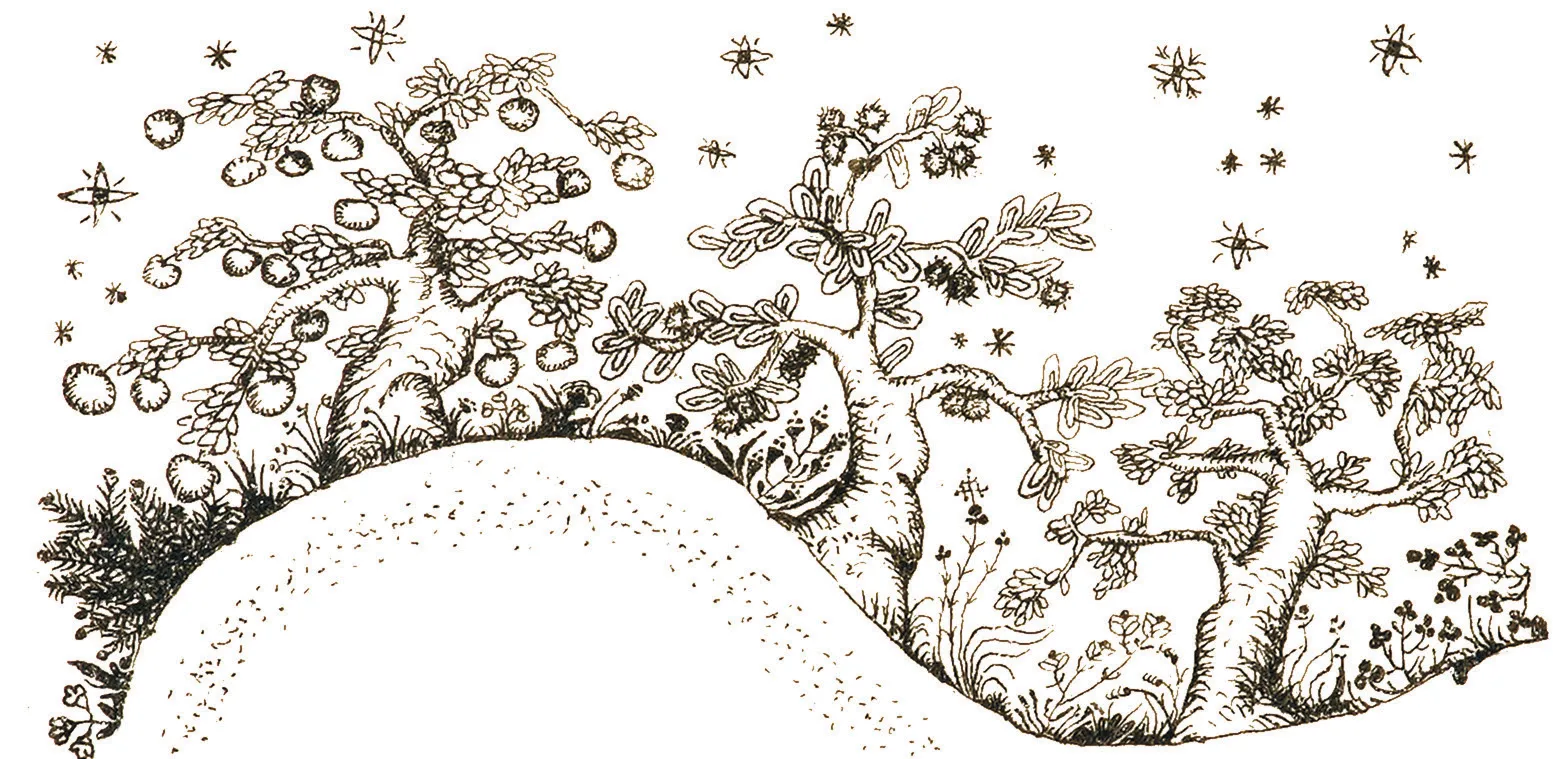
Father Zosima had reluctantly welcomed him into his cell, only after seeing that he had endured the cold of the night for many hours, wandering like a ghost around the haphazardly built dwelling nestled at the foot of a low hill, which seemed to have been transplanted there by human hands. The hermit had listened to his confession without saying a word, murmuring the same prayer endlessly, his chin resting on his chest and his gaze fixed on his chest. Long after Tudor had finished, Zosima seemed to have forgotten all about him. …Had he dozed off? He could no longer hear him praying; he could not even hear his breathing, the sound of his breath melting into the rustling of the branches shaken by the wind, mingling with the strange sounds of the night. Every time the forest crackled, and the leaves lashed wildly against the blind windowpanes, no wider than two palms, chills would prick his hands and crawl up his spine, jolting him into a frozen dance he could not resist. He no longer knew how long he had spent there, but the darkness had begun to lift, every moment of that subtle transformation seeming to last an eternity. Suddenly, the hoarse crow of a cockerel pierced the heavy silence of dawn. Tudor had leapt to his feet, his mind paralysed by fear, and, tripping over the hermit’s cassock, had clumsily toppled over the cast-iron stove that stood guard over the hermit’s place of prayer. ‘Don’t be frightened, lad,’ Zosima had said cheerfully, as if resuming a conversation that had been interrupted just a few moments earlier. “It’s the neighbours’ cockerel; I recognise it by its crow.” “What neighbours…? Who else lives here?” stammered Tudor, embarrassed, as he scrambled back to his spot. “That’s how it sounds out here in the wilderness. The nearest farmstead is three kilometres away, but there’s such peace in these parts that on clear nights I can hear the poor folk saying their prayers before going to bed.” “Don’t be in such a hurry, my boy. Don’t be sorry you came,” Zosima continued kindly. “Have faith; I won’t let you leave here without teaching you what to do!” Defeated and exhausted, Tudor gently rested his head in the monk’s lap and began to weep softly, his hands limp on the earthen floor of the hut, which was mercilessly battered by the cold wind drifting down from the mountains.
[…] “Understanding everything makes one very forgiving,” Father Zosima had whispered to him at their last meeting. He remembered that he had smiled in puzzlement. “Don’t think I’ve spent my whole life with my eyes fixed solely on the Gospel,” the hermit had chuckled mischievously. “Father, I have sinned greatly…”, Tudor had told him, his voice breaking. “I never confessed this to Grama, but I found it impossible to continue my studies. It all began when I realised I could no longer even remember the title of the book I’d finished the night before. At first I thought it would pass, that it was just the effect of the groundless fears that have been tormenting my mind since my teenage years—fears for which I’d given up looking for a cure. But as soon as I woke up in the morning, I realised I’d forgotten almost everything I’d read or discussed with my teachers up to that point. I could only recall fragments, as if I’d been dreaming. I was doomed to start all over again, to attempt the madness of grasping once more, in a single day, the knowledge accumulated over years of study, during days and nights spent within four walls, reading and writing, smoking and dreaming of the great work, without heeding fatigue or what was happening around me. The great work… illusions, ideals fabricated by others. That was when I happened to meet Zina.” “Your forgetfulness is not a sickness of the mind; your mind is sound…”, the monk had replied, with a gleam in his eye that had made him start, for at that moment it had seemed to him that he could hear Grama sprinkling his reprimands upon the open wounds of his mistakes. “…It is simply weary of living with sin, day after day, without respite. But marvellous things are happening to your soul, my boy. Things for which I have no remedy. All I can do now is listen to you and pray. Do not despair; prayers carve steps even into the hardest stone. From now on, however, you will have to carry your own cross, to choose whether you can be worthy of forgiveness and salvation. There is no other way.’
[…] He could already smell the fresh scent of the forest; he saw himself climbing the path once more up to Zosima’s cell, unburdened, with a light step and his chest swelling with the crisp air, and his mind was filled with the vision of such tender joy, which brought him such peace, that he would have embraced with fervour, as a long-lost brother, the first person to cross his path. He was not surprised when he found himself once more before the red-stone walls that flanked the stately houses, embraced by wide porches, which gazed at one another lovingly like two sisters, unconcerned by the turmoil of the town that had grown alien around them, with people coming and going, rushing about recklessly—once young, then old and frail, barely able to walk, leaning with difficulty on their children or grandchildren, their eyes dazed and lost, only to disappear, at last, forever. The tunnel of ivy opened up mysteriously before him once more, its end lost in the dense, winding greenery, adorned with the white tassels of the Hand of the Mother of God and interwoven with the dark flowers of dusk.
After his first few steps, he felt a sense of peace wash over him and soften his senses, compelling him to stop in the heart of the thicket. “Now no one can see me,” Tudor smiled, lighting a cigarette and settling comfortably into the tall grass, his head resting against the thick red-stone walls. He tried, with growing distraction, to follow the ethereal dance of the wispy bluish smoke as it vanished into the green thicket, whilst his mind was overcome by a soothing drowsiness. He heard, as if in a dream, the tolling of a church bell and the howling of the wind as it swept through the branches of the ancient trees that lashed his cheeks, but his eyelids grew heavier and heavier, and he could not bring himself to open his eyes, so comfortable was he there, in the tall, undulating grass, which had completely enveloped his limbs, drained of strength. ‘Where am I?’ had been his last thought, before he surrendered completely to the tranquillity of that realm where all living things were ready to bow to sleep, save for a soul far removed from the world who still kept watch, and the prayer of his watchful tears had also stolen Tudor’s heart, so that together, united, they might experience, if only for a fleeting moment, the comfort of the eighth heaven.