
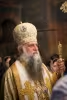
One of the most prominent figures in the history of our national culture and of the Church of our forefathers was, without a doubt, Saint Antim Ivireanul, Hierarch and Martyr, father and shepherd to the faithful people of Oltenia beneath the Mountains for nearly three years, between 1705 and 1708. He truly represented a great gift that the Merciful God bestowed upon our Fatherland and our Church at a time when the foundations of Romanian culture were being laid, with a ruler of holy life at the helm of the country who understood that only true faith, the cultivation of a spiritual life based on the words of Holy Scripture and the teachings of the Holy Fathers, and authentic Romanian culture would ensure the survival of the Romanian people, who have been so sorely tried throughout the ages.
Understanding the episcopal mission to which he was called, Saint Antim devoted all his skill and the gift he had received from God to the service of the Church and the Romanian nation, which he regarded as his own: ‘It is therefore no wonder, my beloved, obedient and honourable boyars of noble birth, that God has appointed me too, and has placed me—a humble and lowly man, a humble shepherd—over a small flock, over you, whom I do not regard, nor do I consider, as a small flock, but as a great and noble one; great for your devout worship and true faith, which you keep pure and unstained, whilst being surrounded and confined within the borders of those of a foreign kind, and beset by so many hardships [that come] and the afflictions that come ever, unceasingly, from those who rule this land; exalted for the good obedience and submission which you ever show towards the Church and towards the Archbishop1”.
The spiritual profile of this humble hierarch is defined by the special care he showed towards the flock entrusted to his pastoral care, for he was not merely a servant of God, but also a servant of mankind, to whom he devoted himself with love and responsibility, in accordance with the words of Saint Paul the Apostle: ‘Pay close attention to yourself and to your teaching; persevere in these things, for by doing so you will save both yourself and those who listen to you’ (Romans 4:16).
The image of the gentle and learned bishop, a man of prayer and diligence, is iconically identified with the witness of Saint Antim of Ivirean. He knew how to translate into his pastoral work the exhortation of Christ the Saviour, who says: ‘Let your light shine before men, so that they may see your good deeds and glorify your Father in heaven’ (Matthew 5:16). The light of the Orthodox faith, which the hierarch of Georgian origin strengthened amongst the Romanian faithful, was complemented by the light of knowledge and teaching: “For just as the human body cannot live without physical nourishment, so too the soul cannot live without spiritual nourishment, which is the word of God”2).
Saint Antim Ivireanul, Hierarch and Martyr, did not neglect the main tenets of Orthodox spirituality in his work as a servant of the Church, aimed at the growth of people in Christ, but rather explored them in depth in his writings, but more than that, through the personal example of his own life. Saint Antim, a true servant of the Church in word and deed, left his disciples and all of us a series of exhortations for spiritual growth, preserved not only in the well-known Didache, but also in various other writings of his, amongst which we may mention: A Brief Teaching on the Mystery of Repentance, Ecclesiastical Teaching, and The Rule of the Monastery of All Saints. Through all his work, we cannot say that Saint Antim enlightened only the lives of his contemporaries, but also ours, the lives of us all, leaving us as a legacy his writings, rich in spiritual teaching.
His entire ministry as a hierarch of the Orthodox Church can be summarised as the work of imprinting the Word of God upon the hearts of the faithful, striving, ceaselessly, to lift man up to God. To this end, he made use not only of the spoken word in his God-inspired sermons and the written word in his books—which he had printed through his own efforts—but also of the word depicted in colour, being a skilled icon painter. His martyr’s death, suffered because he rose up against the oppression of the Ottomans—who would impose the replacement of the local rulers with Phanariot ones in the extra-Carpathian Romanian lands—crowned his work of witness, proving that what he taught through the word was not mere speech, but words springing from the grace of God that dwelt in his heart.
Saint Antim of Ivire, as Bishop of Râmnic, was the one who raised the culture of Râmnic to a level of flourishing it had never before known, by bringing the printing press to Râmnic, thereby imprinting the Word of God both in people’s hearts and on the pages of books. During his nearly three years as bishop in Râmnic, Saint Antim initiated and oversaw the printing of no fewer than nine books, turning the seat of his bishopric into the capital of the printed book. The most important publication to come out of Râmnic during his time was The Book of Joy, a work comprising five polemical treatises directed against the Westerners.
In each book, he imbued his paternal thoughts and spiritual counsel through the prefaces or afterwords he composed, thereby making a significant contribution to our cultural history and to the edification of the Romanian soul, indeed to the national consciousness of the Romanians.
In every book, he conveyed his fatherly wisdom and spiritual counsel through the prefaces or afterwords he wrote, thereby making a significant contribution to our cultural history and to the shaping of the Romanian soul, indeed to the national consciousness of the Romanians.
One of the most important ministries of Saint Antim Ivireanul, Hierarch and Martyr, was that of spiritual guide, a role encompassed within the episcopal mission he had undertaken: ‘My great longing and pure love, and, I might say even more so, the paternal duty I owe to your love, have prompted me to come here today, so that I may examine your souls, since I have been appointed, though unworthy, to be your shepherd, spiritual father and teacher in matters pertaining to the salvation of your souls. For this reason, it is the duty of all of you, from the youngest to the oldest, to heed what I teach you that is good and beneficial; for in doing so, you are not obeying me, but Christ, as it is written in Luke 10: ‘Whoever listens to you listens to Me, and whoever rejects you rejects Me’. Likewise, the blessed Paul says in chapter 13 to the Jews: ‘Brethren, honour your teachers and submit to them, for they watch over your souls, as though they were to give an account, so that they may do this with joy, rather than with sighing, for this is of no benefit to you”3.
Archbishop Antim’s kenotic mission is clearly described by his disciple, the subdeacon Mihail Iștvanovici, in the Preface placed at the beginning of the Prayer Book which he had printed in Râmnic, in the year 1706: ‘Here in our land, not like that Egyptian Pharaoh, but like the gentle one, akin to David, the most enlightened, I say, and our exalted lord and master, Voivode Constantin Brâncoveanu, having come to know and seen you through your love of God, and having examined your keen intellect, found you worthy and skilful, not in the interpretation of dreams [...], but in matters requiring clear-sightedness and practical action; and upon seeing these and comprehending them with his mind, this marvellous lord exclaimed: ‘Shall we indeed find a man such as this?’4
Saint Antim the Metropolitan asks the priests, on the one hand, to take responsibility for the mission they fulfil, and on the other hand, to share the burden of his ministry, as set out in the Church’s Teaching: ‘For the flock is great, and there is but one shepherd; even though he be great in worthiness, and however well-versed in governance and skilful in teaching, he cannot see everything, nor know everything; and for that reason, he has priests and spiritual fathers, who serve the holy shepherd as eyes to see all things, as hands to perform what is necessary, and as feet to run amongst them, attending to the needs of all. It is therefore you, reverend priests, who are our helpers in this great undertaking; you have a ceaseless duty, both in word and through your deeds, to labour and strive day and night alongside our shepherd for the salvation of this flock of the Word, which God has entrusted to our care”5
On every occasion, Saint Antim of Ivirean strove to demonstrate and promote the intrinsic link between worship and culture, between the Word and words, understanding the Church as a ‘school of salvation’. His sermons, delivered in the language of the ancient homilies, are true spiritual treatises, which capture man in his true condition and inspire him to desire the eternal and imperishable inheritance of the Kingdom of Heaven.
‘And they have sent me to you to be your shepherd, your spiritual father, one who prays to God for your good health and salvation and that of your honourable households, one who cares for those things which may be of benefit to your salvation, and to be a source of comfort to you in the tribulations of this world’s Babylonian bondage, like Jeremiah to the people of God and like Joseph, the eleventh son of the patriarch Jacob, to the Egyptians; and together with you I may endure all that the hour and the season may bring, for which I am bound to watch over you with diligence and without sloth, day and night and at all times, for the benefit and salvation of all the community, teaching and guiding you with the fear of God along the right path. And you, too, have a duty, you who recognise what I am teaching you, without pretence or deceit, I urge you to accept and put them into practice, for the spiritual benefit of your souls, and to submit yourselves to obedience; for that obedience which ‘you show to me, you show to Christ’6
The special devotion that Saint Antim of Ivirei had towards the Mother of God was perhaps due to his longing for the image of his own mother, from whom he had been separated at a young age, having been taken captive by the Turks and brought to Constantinople. As a painter and miniaturist, the talented hierarch placed all his trust in the intercession of the Most Holy Virgin Mary. Indeed, the beauty of the words with which he describes the Most Holy Mother of God was also noted by later literary critics, such as George Călinescu, who says: ‘Antim possesses grace and lyrical exaltation, and offers the Virgin a Franciscan eulogy unfolding in a sumptuous cadence, like a peacock’s tail’7
On every occasion, Saint Antim Ivireanul strove to demonstrate and promote the intrinsic link between worship and culture, between the Word and words, understanding the Church as a ‘school of salvation’.
This careful concern of Saint Antim not to stray from the path of sound thinking, from the thinking of the Fathers, is impressive: ‘And so, when I teach these words that I speak, and if they take root in your hearts, then I know full well that you would say I am neither teaching nor advising you wrongly. But I lay the blame for this more upon the priests, for they are the salt of the earth, as Christ says: ‘If the salt loses its flavour, with what shall it be salted?’ That is to say, being themselves uneducated and lacking in discernment, how can they possibly teach the people? For the greatest and most fundamental foundation, the fear of God, is lacking in them; for if it were present, they would also be wise, as Solomon says: ‘The fear of the Lord is the beginning of wisdom’. And if they do not come to their senses, so as to turn towards what they ought to do, they will face a great judgement from God: and you, too, still have a duty to seek out capable spiritual fathers, whom you know to be more learned, so that they may guide you towards what is beneficial, and not just any accursed person. For what use is a so-called doctor who does not know how to heal wounds to the wounded? Likewise, one who calls himself a spiritual father: if he is unlettered and ignorant of the mysteries of the Church, and if he lacks the fear of God, what good will he do to the one who goes to him to confess? All that I have said, I have said out of a sense of duty; and may God, who enlightens the blind and sets the broken-hearted aright, enlighten you too and guide you towards that which is beneficial’8
Spiritual guidance, the central focus of the ministry of Saint Antim Ivireanul, the Hierarch and Martyr, Metropolitan of Wallachia, also becomes a priority theme in his writings. His correct understanding of the Word of God made him a living and fearless witness to Christ the Saviour, dedicating his entire life to the service of the Church and the Romanian people, nurturing the seed of God’s Word in the hearts of the faithful, as he himself stated in his sermon on his enthronement as Metropolitan of Wallachia: ‘And I pray to His goodness and His love for mankind to enlighten my mind so that I may preach the word of truth, and to strengthen my heart in the fear of Him, so that I may shepherd His chosen flock, whom He has redeemed with His most precious blood from the hand of the enemy’9”.
A polyglot intellectual and a profound connoisseur of Eastern Christian spirituality, the Georgian hierarch fully understood the importance of language as a means of communion and communication with God and with people. For this reason, the particular merit of Saint Antim of Ivire is that of having consolidated the use of the Romanian language in the worship of the Orthodox Church, with the liturgical books he had printed becoming beacons of comfort for the hearts of the priests and faithful of that time: ‘But in church I would rather speak five words with my mind, so that I may teach others, than ten thousand words in a foreign language’ (1 Corinthians 14:19).
Although he was primarily concerned with building the Church within people’s souls, Saint Antim did not, however, disregard churches as places of worship, the earthly porches of the Kingdom of God. As Bishop of Râmnic, Saint Antim Ivireanul oversaw the restoration of many churches and monasteries in this diocese, such as Surpatele, Fedeleșoiu, Cozia and Govora, three of which still preserve, his blessed presence to this day.
His martyr’s death is the supreme proof of his faith in God and his refusal to compromise with the world. This can be seen in the dignified stance which Saint Antim adopted in the face of the Ottoman authorities, who were forcing the replacement of the local rulers with Phanariot rulers in the Romanian Principalities. Like an Apostle, the hierarch of Iviere bore witness with his own life that he feared not those who can kill the body but cannot kill the soul (cf. Matthew 10:28), thus taking his place for all eternity amongst the holy martyrs. ‘For I am convinced that neither death nor life, neither angels nor principalities, neither things present, nor things to come, nor powers, nor height, nor depth, nor any other creature, will be able to separate us from the love of God which is in Christ Jesus our Lord’ (Romans 8:38–39).
Like an Apostle, the hierarch from Iverea bore witness through his own life that he feared not those who can kill the body but cannot kill the soul.
Although he was not of Romanian descent, through the grace of his words and his life, Metropolitan Antim was loved and cherished by our people, who saw in him a true ‘man of God’.

- 1
Saint Antim of Ivire, ‘This is what I said when I became metropolitan’, in Didahii, edited by Archimandrite Mihail Stanciu and Professor Dr Gabriel Ștrempel, Basilica Publishing House, Bucharest, 2010, p. 55.
- 2
Saint Antim of Ivire, ‘Sermon on Bogoiavlenie’, in Didahii, p. 108.
- 3
‘On the Sunday of the Publican. A Sermon’, in the Didache, p. 177.
- 4
Evhologhion, or Molitvenic, vol. I, Râmnic, 1706, fol. 3.
- 5
‘Church Teaching’, in Saint Antim of Ivire, Writings, Basilica Publishing House, Bucharest, 2016, p. 117.
- 6
Saint Antim of Ivire, ‘This is what I said when I became metropolitan’, in Didahii, p. 56.
- 7
George CĂLINESCU, A History of Romanian Literature: A Compendium, Editura pentru literatură, Bucharest, 1968, p. 19.
- 8
‘Sermon for Cheesefare Sunday’, II, in The Didache, pp. 204–205.
- 9
“I said this when I became a metropolitan”, in Didahii, p. 97.