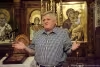
I first met Father Dumitru Stăniloae in early November 1982. I had written an article about his daughter’s poetry, entitled ‘The Poetry of Lidia Stăniloae’. I was introduced to him at her flat in a small block of flats near the Church of the Holy Friday. Before this meeting, I had borrowed and read all of Father Stăniloae’s books up to Jesus Christ or the Restoration of Man (1943), and the course on asceticism and mysticism, which I would later reread so many times. I cannot recall what we discussed on that occasion. I do, however, remember him wearing a cassock, with hair as pure white as platinum, cut relatively short. Then there was the youthful appearance of his grandson Dumitraș, who was studying Theology…
I never saw Father Stăniloae dressed in anything other than his cassock, in his cramped flat at 6 Cernica Street, seated at a desk that looked more like a school pupil’s desk. There were few books in the room, and none of them were his own. Icons predominated in the room – I am reminded of the icon of Saint Calinic and the great theologian’s poignant exclamation at the canonisation of our saints in 1955: ‘You, Romania, have humbly kept your saints hidden!’ – a candle, images from the Holy Places… On the sofa sat his wife, a frail woman, yet full of life, who, after December ’89, when I brought guests from abroad to visit them on a couple of occasions, quietly warned me: “Don’t tire Father out…”. Yet the visit would drag on each time, and the priest would speak in his calm, even and affable tone. That is how I met him for the last time, in early December 1992. We went to visit him – the head of the BBC’s Romanian Service, Ruxandra Obreja, an editor and myself. Father Stăniloae had had a minor accident and apologised that he would be receiving us whilst lying on the sofa. Yet he was still wearing his cassock. Once the interview had finished and she’d switched off the tape recorder, Ruxandra asked him: “What was the world like 60 or 70 years ago, Father?” “It was beautiful. Priests truly belonged to the community; bishops were close to the people…”. And he began to speak as if he could see that past vividly before him; his eyes – a deep blue – had lit up.
With a tape recorder identical to Ruxandra’s, I had gone there in the summer of 1992, in June, before Father Stăniloae was to be awarded an honorary doctorate by the University of Bucharest. It was a Saturday. The ceremony was due to take place in two days’ time. He spoke to me for half an hour, beginning with: ‘Now, at an age when worldly honours no longer bring joy or hold any interest…’. A few days later, unaccustomed to tape recorders, when His Eminence Nicolae Corneanu, Metropolitan of Banat, had come to my home for a similar conversation, I accidentally erased the recording, overwriting it with the recording of the high-ranking hierarch.
Perhaps March 1990… Seated at his desk – it was just Father Stăniloae and myself in the room – he said to me: “All sorts of parties, associations and organisations have been coming round here; they’ve remembered me too, but I’m not involved in politics…”. And he had never been involved in politics his whole life. He considered himself, first and foremost, a priest.
Two months earlier, in mid-January 1990, I had been noting down – for the magazine ‘Amfiteatru’ – his answer to the question: were the young martyrs of December ’89 martyrs? Here is his answer: ‘I would compare the martyrs of the Revolution to the infants slain by Herod. By a modern Herod, far more cruel, who could not tolerate Christ. The infants killed by Herod were unaware of their sacrifice, whereas the martyrs of December knew they were going to their deaths. Their sacrifice must be canonised and should take on a global Christian significance. May all the Orthodox Churches commemorate them (…). Our martyrs could be celebrated either on 22 December or on 20 December, together with the infants killed by Herod.”
He loved literature very much, and poetry in particular. In the autumn of 1991, I took the critic Radu Călin Cristea to meet Father Stăniloae – he addressed him in the Transylvanian manner as ‘Father’, and this pleased him – who was surprised to hear how highly he valued the poetry of a modern poet, Daniel Turcea. Here, in fact, is what he said on another occasion about poetry: ‘If poetry is the concentrated expression of the infinite and supreme wonder of existence, it is a fitting form for expressing faith in God. It is, moreover, a suitable form precisely because the mystery of God cannot be defined in direct, rational terms, and therefore metaphors—drawn from the visible world, but viewed in an infinite dimension and spiritualised.”
I caught him red-handed in a moment of sentimentality just once. It was when he said to me: ‘Why don’t we have writers of the stature of the Russian writers, of Dostoevsky?! Why don’t writers seek to say something profound about our soul?’
He was impervious to Caragiale. I tried to convince him that Caragiale was a Christian writer, at least in Năpasta. He gave me no reply.
On Christmas Eve 1984… For several months I had been running a column of nearly four typewritten pages, ‘Revista revistelor’ (‘The Magazine of Magazines’), in the ‘Literary Supplement’ edited by Ion Cristoiu. In the 1985 Literary Almanac, which had been published in mid-December ’84, an extract from Father Stăniloae’s essay—which was then in manuscript form (and published in Craiova in 1992)—entitled ‘Reflections on the Spirituality of the Romanian People’ had been printed. Under the heading ‘The Balance of the Romanian Soul’, I reproduced three pages from this text, preceded by an introductory paragraph in which I spoke, of course, not of the theologian, but of the great Byzantinologist Dumitru Stăniloae. All this took place with the complicity of Ion Cristoiu, who, having been invited by me to a monastery near Bucharest, was not ashamed to cross himself in public at the end of the prayer said before the meal began. So, too, was his wife.
Ion Cristoiu suggested that we print a magazine page featuring excerpts from Father Stăniloae’s essay, which he had entrusted to me following the publication of the aforementioned article. The page was typeset, but it never appeared. Three or four months later, in April 1985, my column was also suspended. In the winter of that same year, 1985, Valeriu Gherghel and Liviu Antonesei, who edited Opinia studențească in Iași, asked me for a page for their magazine featuring aphorisms translated from E.M. Cioran. I sent it, accompanied by a letter in which I suggested Father Stăniloae’s text on ‘Longing’. And so, those eight typewritten pages appeared in five consecutive issues of Opinia studențească, starting with issue 1/1985.
When I took the magazine to Father Stăniloae that summer, and he saw Cioran’s name on the opposite page, he told me about his friendship with Cioran’s father, the priest Emilian Cioran, archpriest of Sibiu in the 1930s and godfather to his own daughter. It was then that I learnt that Cioran’s mother came from a noble family, related to Andrei Șaguna, and that Șaguna used to come and stay at one of this family’s country estates.
Father Stăniloae had met E.M. Cioran again in Paris and told me how, whilst visiting him at home with a young Romanian theologian who had started leafing through a book lying on the table, the writer snatched it from his hand: ‘Put it down! Don’t let the priest see this rubbish!’
Cioran also confided in him how, after the earthquake of 4 March 1977, having gone out onto the street and feeling indignant that Parisians were strolling about and enjoying themselves whilst the Romanian people were enduring a tragedy, he felt like smashing all the shop windows to smithereens. Father Stăniloae spoke to me on two occasions about this episode. Just as he told me, when he showed me the photographs of Mircea Eliade, taken during his visit to the United States in 1983, that the scholar, who was with his wife, asked him before the meal began: ‘Say grace, Father!’
Hearing about his relationship with the two Ciorans, father and son, I said: “Why don’t we send him the magazine too?” “If you say so…” And on a long envelope he wrote the address: 21 rue de l’Odeon.
I wasn’t convinced that the envelope—containing an issue of the magazine Opinia studențească and a short letter from Father Stăniloae, which I took to the post office and sent by registered post—would reach its destination. Although I set off with it unsealed, a twinge of conscience stopped me from copying that letter which had been read to me—a letter superb in its simplicity and generosity; a letter which began, as I remember precisely, with ‘Dear Mr Emil’. There was an age difference of only eight years between the sender and the addressee, yet Father Stăniloae wrote to him: ‘You are young, in the prime of life, in the thick of your work, and I rejoice in the successes you are achieving…’
Obviously, Father Stăniloae could not share Cioran’s ideas, but he approached them with great understanding and forbearance, characteristic of the Orthodox East, which fully respects everyone’s freedom. I believe it was early July 1985 when Father Stăniloae rang me: ‘You know… that letter of ours… I’ve received a reply. Come and have a look at it!’
The text of that letter has been published several times, initially in the 25 May 1991 issue of the newspaper România liberă. I reproduce it here: “Paris, 22 June 1985// Dearest Father Stăniloae, dear friend,// Thank you for your letter and for the lovely article on longing. At the same time, please convey my thanks to Dan Ciachir for the aphorisms translated in various magazines.// I told you in Paris, and I repeat, that the Philokalia is a monumental work in the history of our language. At the same time, what a profound lesson for an unfortunate and frivolous nation! From every point of view, such a work is destined to play a significant role. I am unspeakably proud to have known you for more than half a century.// With all due respect and friendship,// Emil Cioran”.
What surprised me when I held the letter, folded into quarters, in my hand was the fact that, apart from the date, it was written entirely in Romanian. I knew, like so many others, that he wrote to his own relatives in nothing but French.
A priestly conscience, sincere, natural humility were the defining traits of Father Stăniloae, who made no mention of his work or his books, of the fact that he had been translated into numerous languages, or of the praise that renowned theologians and philosophers wrote or spoke of him… He was genuinely concerned about the fate of his people, troubled by the acute decline they had been experiencing during the final years of communism. I realised the extent of his innate humility when he urged me: ‘Write, work, become a true Christian writer. I believed I would achieve very little.’ And what he had achieved seemed to him to be a gift from God.
‘A sense of the priesthood, sincere, natural humility were the defining traits of Father Stăniloae, who never spoke of his work or his books, of the fact that he had been translated into numerous languages, or of the praise written or spoken about him by renowned theologians and philosophers… He was genuinely concerned for the fate of his people, troubled by the acute decline they had been experiencing during the final years of communism.”
Elected a corresponding member of the Academy at the age of 85, he—who held honorary doctorates from several European universities—accepted the honour with modesty, and when I congratulated him on finally becoming a ‘full’ member at nearly 90, he replied with humour – for he did have a sense of humour – ‘It was about time’.
The hierarchs of our Church were in no hurry to visit him until December ’89. Patriarch Iustin Moisescu had halted work on the Philokalia at the tenth volume – he felt he was writing too much – but when this patriarch, who was himself a brilliant intellectual, died on 1 August 1986, I heard his grief-stricken voice on the telephone: ‘The Patriarch has died!’ He regarded him as a genuine and tormented man.
He spoke just as warmly of the other patriarch, Justinian Marina, who steered the ship of the Church through the darkest days of communism: ‘Justinian always had a kind word and a word of encouragement for everyone’. Yet this patriarch, too, took no liking to him whatsoever and offered him no help whatsoever.
He once told me how, in prison, where he spent nearly five years, he had noticed a fellow sufferer—a shopkeeper whose shop had been confiscated—who, discreetly but systematically, refused food. He wanted to die of malnutrition. Father Stăniloae whispered gently to him: ‘What you want to do is the greatest sin – suicide.’ The man listened to him and, later, when they met again after his release, he said to him: “Thank you, Father; you were right.”
When he was awarded an honorary doctorate by the St Sergius Theological Institute in Paris, he told me how kindly Virgil Ierunca had treated him. He drove him everywhere and waited for him. “What sort of car does Ierunca have?”, I asked. “He doesn’t have a car. He took me everywhere by taxi.” Years ago, in a Cluj-based magazine, I read Virgil Ierunca’s review of Orthodox Dogmatic Theology and was struck by the insight of his commentary.
He loved and held Nicolae Steinhardt in high regard, but he denied the rumour that Steinhardt had baptised him as a Christian whilst in prison. He had been baptised by Father Mina Dobzeu, the abbot of the Monastery of ‘Saints Peter and Paul the Apostles’ in Huși.
Also in the winter or spring of 1985, Father Stăniloae placed in my hands the book by Vladimir Lossky, the famous Russian theologian in exile, Essai sur la Théologie mystique de l’Église d’Orient, saying to me: “I beg you to read this book!”
