On the night of 16–17 February 1918, the holy relics of Saint Dimitrios Basarabov, the patron saint of the Romanian capital, which were kept at the Metropolitan Cathedral in Bucharest, were stolen 1. Upon being informed, Metropolitan Primate Konon acted immediately, without waiting for daybreak, and ordered the great bell of the Metropolitan Cathedral to be rung. Also during the night, he sent word to Field Marshal Mackensen, asking him to be roused from his sleep and to take measures to apprehend the thieves. This heinous act was committed by ‘up to 20 armed soldiers who, following a well-prepared plan, plundered the church, striking a blow both against the interests of our Orthodox Church and against the faith and interests of the Romanian people’2). The Metropolitan called for the most urgent measures to be taken and for the holy relics to be intercepted wherever they might be found.
In the cathedral courtyard, across the entire hill and at the entrances to the Metropolitan See, pilgrimages of the faithful were taking place, as they prayed for the culprits to be found. Mackensen, seeing these demonstrations, feared an uprising in Bucharest and gave orders to set off in pursuit of the thieves in two German cars, to catch them and bring them back to the Metropolitan Cathedral. The German units, which controlled the customs checkpoints across the Danube, were notified by telephone to carry out thorough searches and to stop any suspicious car or convoy.
On 18 February 1918, the following day, a communication in French was received from Bavarian General Zach, head of the German military command in Vlașca County, stating that “the relics of Saint Demetrius, in a magnificent silver coffin, had been stolen from a church in Bucharest, to be transported by car to Bulgaria. Upon reaching Călugăreni, they swapped the car for a small horse-drawn cart in order to cover their tracks… Near the village of Daia, the cart in question was found, accompanied by heavily armed Bulgarian soldiers’3”.
The German general, impressed by this, concludes that the event deserves to be recorded in Romania’s religious history. Following investigations, it was established that the reliquary containing the holy relics had been stolen during the night of 16–17 February 1918 by Bulgarian soldiers, who had been wandering around the capital that night, unable to find their way to Giurgiu, where they had intended to go. When they finally discovered the correct route, their car broke down three times, until they were forced to load the reliquary onto a cart, as recounted in the German communiqué 4. This miracle is particularly interesting, as it was recounted by a witness who belonged to a faith other than the Orthodox Church.
Thanks to the prompt intervention of the German military authorities, alerted by representatives of the Romanian administration in the occupied territory, the holy relics were recovered and returned, with great pomp, in the Metropolitan Church on the evening of Wednesday, 7/20 February 1918. “There were people as numerous as sand”5. Witnessing this ceremony, the elderly Lupu Kostaki, the highest-ranking representative of the Romanian Government remaining in the occupied territory, noted: ‘All the religious services were conducted before such a vast crowd as I had never before seen in my own country, and I shall not be exaggerating if I say that, from the time the holy relics were stolen until their return to the church, almost the entire population passed through the Metropolitan See twice. Although there was a severe shortage of candles, nevertheless, everyone who came had one or two small wax candles. Of course, at that moment I saw that there is religious faith amongst the people. With great persistence, we managed to persuade the Germans—who had apprehended the thieves and brought the Saint back—to allow each person to receive a small memento; we did this primarily because the people were asking for it. Since then, at our request, the Germans have established military guard posts at all our most important ecclesiastical and cultural institutions”6
Following this ‘return’ of the holy relics, as an offering of thanksgiving to God and as a sign of devotion to Saint Demetrius, the faithful placed a beautiful candle beside the reliquary containing the holy relics, in the Metropolitan Church (now the Patriarchal Cathedral), symbolising the light of faith and the Saint’s grace-filled presence amongst the Romanian people. The inscription engraved on the candlestick reads as follows: “The Romanian faithful give glory to God and to Saint Demetrius for the miracle of the Saint’s return. February 1918”. It has become a symbol of spiritual continuity, burning almost continuously ever since, until 1967, when Patriarch Justinian donated it to the church dedicated to ‘Saints Constantine and Helena’ in the village of Ciunget, Malaia commune, Vâlcea County.
The church in Ciunget was built between 1930 and 1967. Work on it was completed in the mid-1960s. Among those who provided financial support for the completion of the place of worship was the Blessed Patriarch Justinian Marina, who donated the sum of 15,000 lei to the church, towards the cost of the frescoes, which amounted to 41,250 lei.
Father Gheorghe Georgescu, who oversaw the construction of the church, was a primary school classmate of the future Patriarch Justinian in Stănești, Vâlcea. During one of the visits the priest made to the Patriarch, as the time for the consecration of the church drew near, the latter presented the holy place with selected candelabra and this candle, which for a long time illuminated the holy relics of Saint Demetrius of Basarabi, housed in the Patriarchal Cathedral in Bucharest, whose feast day is commemorated by the Church on 27 October.
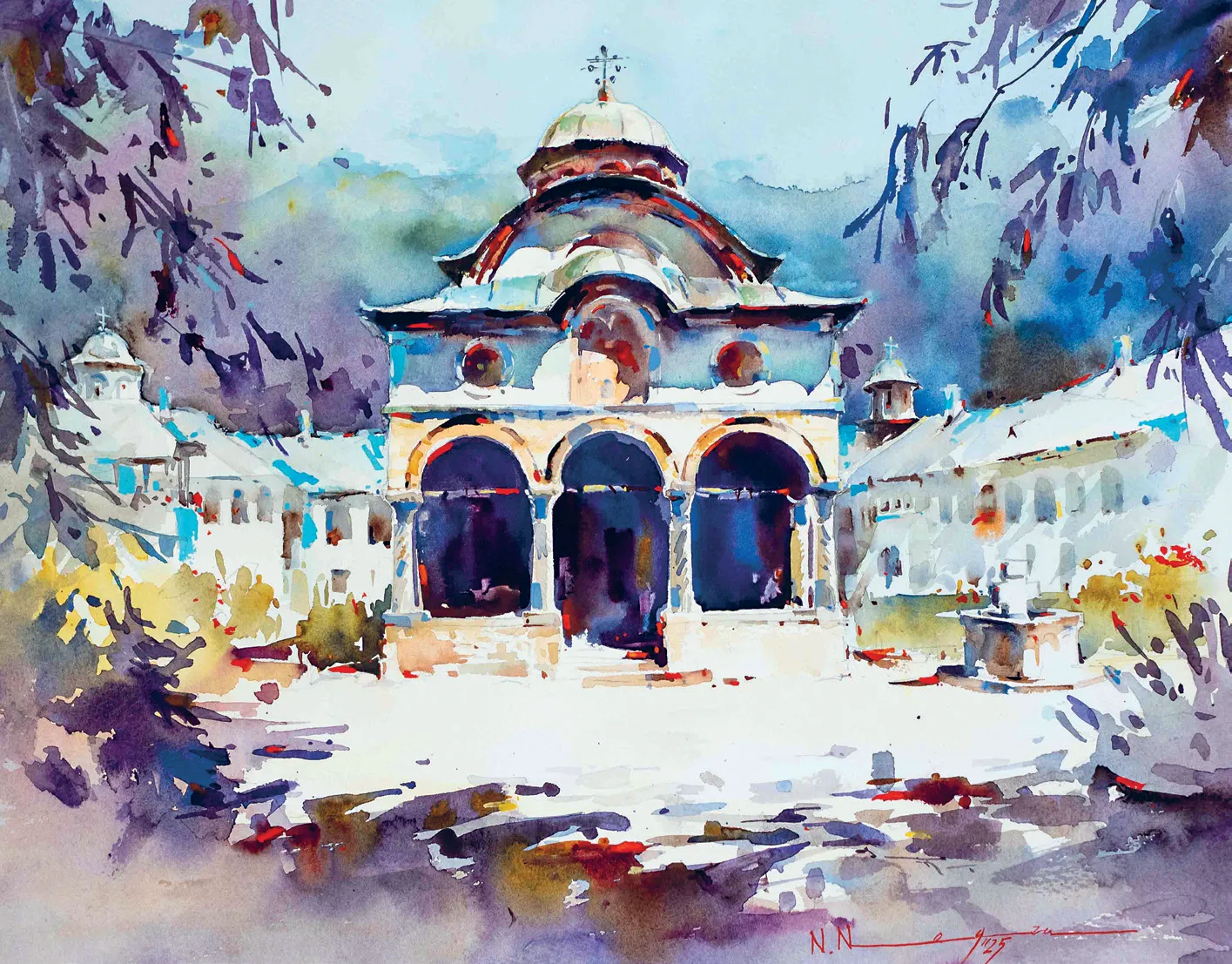
The candlestick was placed in the Holy Altar, above the Holy Table, in the new church in Ciunget, where it remained until 2024. It was then installed in the wooden church, situated near the new church and which has been declared a historic monument. It is dedicated to ‘Saints Constantine and Helena’ and was consecrated by Saint Calinic of Cernica on 10 August 1861.
- 1
Journal of the Romanian Academy Library (hereinafter cited as BAR), Vol. 3, No. 1, January–June 2018, pp. 101–119.
- 2
The Romanian Orthodox Church, 1923, no. 13, p. 994.
- 3
Ibid.
- 4
Hieromonk Teofil Ionescu, Saint Dimitrie the New. The Akathist. His Life. The miracle that took place when he was abducted by the Bulgarians during the occupation, Bucharest, 1935, p. 35.
- 5
BAR, Manuscripts, M. Theodorian-Carada Collection, II mss. 6b, f. 188.
- 6
BAR, Manuscripts, Al. Lapedatu Archive, XIX, varia 17, Memorandum by Mr Lupu Kostaki, the guarantor of the Ministry of the Interior, during the Great War, which he entrusted to the lawyer N. A. Papadat to act as his defence counsel should criminal proceedings be brought against him, pp. 57–58. This information is contained in a ‘Special File for the year 1918’