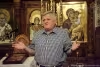
In the spring of 1989, Father Anania – as he signed his letters – was a retired archimandrite who had been living in seclusion for seven years at Văratec Monastery, where he had begun to ‘diortose’ – that is, to stylistically refine – the Romanian version of the Holy Scriptures. From 1976, after returning from the United States, he had held the post of director of the Patriarchate’s publishing house, which he had left in the summer of 1982 following a conflict with Patriarch Iustin. I had met him at the enthronement of Metropolitan Antonie of Transylvania, in February 1982, where I had been invited – I had only just turned 30 – both to the enthronement in the cathedral and to the official banquet in the halls of the ‘Împăratul Romanilor’ restaurant in Sibiu. The new Metropolitan of Transylvania had also invited a dozen writers and intellectuals to his enthronement – most of them second-tier figures – who had supported his cultural and literary endeavours. Or ‘publicists’, as Patriarch Iustin was to describe them in his speech – a man publicly admired by Noica, both as a Hellenist and a doctor of the University of Athens, and by President Karamanlis of Greece, who had told him, also in public: “This is how we ought to speak our language – with the elegance with which Your Holiness speaks it.”
At the dinner on 6 February 1982 at the ‘Împăratul Romanilor’, I recognised Valeriu Anania, the writer, standing a few metres away, by his bushy eyebrows, as black as the cassock he wore, streaked with a few white hairs. I watched him closely, knowing that he was the author of two well-known plays, Miorița – with a preface by Arghezi – and Meșterul Manole – both performed on theatre stages. Playwright and monk. Or: monk and playwright. I had come across his name mentioned in literary magazines on more than one occasion. He was a man in his sixties with a distinguished, resolute yet distinctive countenance, over which hung a shadow of patient, polite resignation, as those flat, insipid speeches – typical of the installation of a bishop or metropolitan – followed one after another.
I approached Father Bartolomeu Anania a day later, in the corridor of one of the three first-class carriages in which the guests of the Metropolitan of Transylvania were returning to Bucharest. Thus began a friendship that lasted nearly three decades, of the master–disciple variety. I had previously had the opportunity, almost identical in nature but of much shorter duration, in the early 1970s, to form a close bond with Alexandru Paleologu. From 1982, Father Anania lived at Văratec Monastery, in the building formerly occupied by Bishop Partenie Ciopron, but he would come to Bucharest for periods of varying lengths, where, after leaving his double cell or ‘monastic flat’ within the grounds of the Archdiocese of Bucharest, he had bought a studio flat on the first floor of a brick-faced block of flats behind the ‘Adam’, built in the early 1960s and situated on the border with Cișmigiu Park and the building of the former Ministry of War in Valter Mărăcineanu Square – or rather, Valter Mărăcineanu Open Space. It was there that I had listened to him for hours on end, in the evenings and at night, on a couple of occasions until the break of dawn. During those hundreds of hours of conversation, I learnt the true recent history of our Church and came to know the sacrifices it made during the years of the communist regime. Had it not been for those long meetings, I would never have learnt who Patriarch Justinian really was, and I would have fallen into the trap of the ‘red patriarch’ into which so many had fallen. The same history of the Church was also attested to by the abbots I knew, but Father Anania spoke clearly, concisely and methodically. He did not avoid any question, did not evade the issue, nor did he resort to sophistry or paradoxes.
Over the course of those hundreds of hours of discussion, I learnt the true recent history of our Church and came to understand the sacrifices made during the years of the communist regime.
Father Anania possessed a special gift – rare in people and exceedingly rare among Romanians: every statement he made was confirmed sooner or later. It was true, even if at the time it seemed incredible, absurd, paradoxical, or at odds with general belief. Gradually, after the collapse of the former regime, we realised that all Father Anania’s testimonies and words were an expression of the truth. I shall cite, in this regard, a single, telling example. Lucrețiu Pătrășcanu was held in high regard even by anti-communists for the statement – ‘I am first and foremost a Romanian, and only then a communist’ – which he is said to have made in 1946 at the University of Cluj. Minister of Justice at the time, as well as a university lecturer, Pătrășcanu had travelled to Cluj to quell the students involved in a strike in which Anania, a monk and medical student, was playing a leading role. As far back as the 1980s, Father Anania told me that Pătrășcanu did not make the statement attributed to him; neither in 1946 in Cluj, nor on any other occasion. Today, historians confirm this: Pătrășcanu never said that he was first and foremost a Romanian and only then a communist; this statement was attributed to him by his accusers during the trial that led to his execution... Back in the 1980s, I found it hard to accept another, highly paradoxical, statement by Father Anania: namely, that there had been people who had deliberately gone to prison in 1948 or ’49 so that, upon the ‘arrival of the Anglo-Americans’, they might claim a ministerial portfolio by virtue of the suffering they had endured... And this was true. There was even a bishop who had agitated for this very purpose, a fact that emerges from documents published by historians.
In April 1989, during Lent, Father Anania rang me, saying, using an old-fashioned expression for unmarried young men: “Young man, what would you say if we paid Lavrentie a visit?... I miss Căldărușani. Perhaps you could ask him to send us the car...”
Father Lavrentie was the abbot at Căldărușani. The monastery’s car was an ARO with a single seat at the front, next to the driver, and two transverse benches at the back, reminiscent of the vans used to transport prisoners. Father Anania, who had spent six years at Gherla and Aiud, corrected me: those looked completely different and were terrifying. On the way, he told me about Căldărușani in the 1950s, when the monastery’s former lake was teeming with crayfish, which had disappeared three decades later. In Căldărușani, Father Anania used to arrive at that time in the old Dodge belonging to Metropolitan Firmilian of Oltenia, a hierarch with artistic taste and a spiritual lyre—that is to say, a poet.
Abbot Lavrentie admired Father Anania, with whom I had once visited him, much to his delight, at Sinaia, a monastery he had led from 1981 to 1987. On the Saturday afternoon in April 1989 when we arrived in Căldărușani, I took Father Anania for a trip in a light, spacious fibreglass boat, painted green, which the abbot had borrowed the previous summer from a cottage on the opposite shore of the lake, to use whilst we were staying there. We travelled about six kilometres across the water with Father Anania, passing a small fish-smoking shed on the way, and reaching Grădiștea. We were discussing the ‘Letter of the Seven’, a politically motivated protest cloaked in cultural terms, the broadcast of which on ‘Radio Free Europe’ was announced every hour on the radio news. We both knew that the protest had been signed by eight writers, and we wondered who might have changed their mind at the last moment. That evening, at the monastery, our discussion over the Lenten meal went on until after midnight. The next day I did not feel up to attending the Liturgy, where Father Anania had presided, that is, taken the lead in the service. The service had long since ended; I was still in the room where I had slept when a young monk knocked on the door to tell me that the Patriarch, who had arrived in the meantime, wished me to join him for dinner.
A few minutes later I entered the patriarchal apartment in the same wing of the abbey building, constructed around 1850, with windows and a covered veranda facing the western side of the lake. At the head of the oval wooden table in the dining room sat Patriarch Teoctist, in a white cassock, bareheaded, with the engolpion around his neck, and a purple sash tied round his waist; to his right sat Father Anania, beside whom I was to take my seat. The Patriarch extended his hand to me, asking how I was, then I shook hands with the other two people who had come with him: a gentleman in his seventies, with only a few strands of hair on his head, dressed in a well-pressed double-breasted suit, with a matching tie and a white handkerchief in his pocket, evoking the typical interwar style of dress. In fact, he had served the Patriarchate as an accountant since those days, around 1939. His name was Ionescu and he was married to the writer Ioana Postelnicu, who had made her name as a prose writer during the same era.
The youth of the monk standing beside the Patriarchate’s accountant was all the more evident by contrast. After I shook hands with Protosinghel Daniel Ciobotea, the Patriarch exclaimed: “Dan and Dan…”, an allusion to the baptismal name of his new adviser – the future Patriarch Daniel – and to my own. Then the grace before meals was said.
Between 1982 and 1989, when I visited him frequently – I lived a few hundred metres from his home in Bucharest – Father Anania was something of an outsider, particularly after his retirement, within the clergy and especially amongst the hierarchy. The retired professor Dumitru Stăniloae found himself in a similar situation. There were members of the hierarchy who valued Father Anania’s character and literary work, such as Archbishop Antim Nica of the Lower Danube or Vicar Bishop Justinian of Cluj, but the author was regarded as someone who had fallen out of the mainstream. Perhaps that is why he was so delighted by the reception of one of his books, Rotonda plopilor aprinși (The Rotunda of the Blazing Poplars), first published in 1983. I have reread it countless times and I believe that is where his great memoiristic treasure lies, more so than in Memoirs, where his egocentricity becomes acute.
Of Father Anania’s plays, I liked The Burden of the Earth best; only Iorga has ever managed to make Byzantium seem so vivid and close to us. Ever since my school days, when I realised, whilst reading Baltagul, that Sadoveanu, like Marin Preda, lacked the gift of creating—in Paleologu’s words—not ‘female characters’, but women (Vitoria Lipan striking me as a hermaphrodite), I have not opened a single book by Sadoveanu. I made an exception in the mid-1980s with Creanga de aur for reasons to do with Byzantium. Yet Sadoveanu’s Byzantium was a Masonic one, mystified and false, just like the esotericism that Vasile Lovinescu sought by candlelight in Craii de Curtea-Veche. It was then that I recalled Greul pământului, its expressiveness and authenticity.
In 1982, Father Anania gave me the volume File de acatist and it was then that I discovered a brilliant poet, who breathed new life into hymnography in our time; the two poems, dedicated to that ‘young abbot’ Ioan Valahul and to Saint Calinic of Cernica respectively, possess a pure and fresh language, a rich, effervescent spirit of praise that endures not merely at the level of language.
Later, I came across that marvellous line: ‘The nobility of being alone and the right to sadness.’ It is an astonishing line. Upon coming across a translation by Father Anania of a poem by Saint Gregory of Nazianzus, published in a church magazine in 1956 or ’57, before he was arrested, I saw the kinship—not merely stylistic—with ‘that all too sad Gregory’. I was surprised to hear an abbot of Nicula Monastery, a Moldavian by birth and of a lyrical disposition, say that Father Anania was a loner. I believe he meant that ultimate solitude also evoked by those close to Nae Ionescu.
Whilst he was writing at Cerurile Oltului, Father Anania asked me if I would like to translate Petru Cercel’s Hymn from Italian. I replied that, however hard I might try, I would not come even a quarter of the way to matching the musicality and fidelity of Al. Ciorănescu’s version, which he had adopted.
I hold Cerurile Oltului in high regard, where an Orthodox Socrates, in the style of the Paterikon, converses with a disciple about the icon and the ecclesial sphere. This volume is superior to Evdokimov’s book on icons, as its author has the advantage of being a theologian, priest, monk and writer.
Both in the rooms where he lived on the first floor of a building belonging to the Archdiocese of Bucharest – from where the Securitate arrested him in the early hours of a summer morning in 1958 – as well as in the studio flat in the block of flats near Cișmigiu, I was surprised to see a rather large photograph of Father Anania hanging on a wall, or his likeness drawn in pen by a friend who was a graphic artist. I hadn’t lost my mind, perhaps because on the first day of September 1981, at Bishop Antonie Plămădeală’s residence in Buzău, I had spotted photographs on the wall of his office showing him with Pope Paul VI, King Gustav of Sweden and a monarch from the Netherlands… ‘The nuns; the nuns put them here,’ the bishop had explained to me, noticing my puzzled look. He was also a writer, the author of a work of pure fiction: the novel Three Hours in Hell.
Father Anania never sought to give me an explanation, whether frank or Jesuitical, for the portrait of himself on display in his home. One evening, to illustrate a point, he stood up to fetch the Testament of Patriarch Justinian from a drawer in the bookcase so that he could read me a passage. Taking two steps, I said to myself: ‘This man has the bearing of a metropolitan.’ It was a spontaneous and firm conviction, much like that of 1969, when I had heard Țuțea – regarded by many as a senile mythomaniac – speaking on equal terms about Eliade, Cioran, Curzio Malaparte, or recalling episodes from his career as a diplomat in Moscow.
Father Anania had two mentors, whom he did not hesitate to acknowledge: Arghezi and Patriarch Justinian. He told me how he had been appointed by the latter, on the occasion of the canonisation of Romanian saints in 1955, as interpreter and companion to a metropolitan of the Russian Orthodox Church. The young deacon came to speak quite frankly with him, so much so that, over a glass of wine one evening, he asked him why the Russians had not sought to capitalise on the defeats suffered by Stalin in the early months of the war with Germany by rising up against the Communist regime. “Because the Germans,” the Metropolitan explained, “had started claiming that the Slavs were an inferior race, and the Russians even more so...”
I met Father Anania in December 1984 at the enthronement of His Eminence Gherasim as Bishop of Râmnic. It was a small gathering in the bishop’s palace, attended by Metropolitan Nestor of Oltenia, the newly enthroned bishop, and the Minister for Religious Affairs, whose secretary—seated at the other table with us—discreetly crossed himself after the blessing… That table on the ground floor of the diocese’s administrative building was reserved for second-tier guests; it was there that Father Anania shone with his wit. One of the nuns asked him: “Do you still remember, Most Reverend Father, how you taught us, in Bucharest, at the Palace, that we must serve from the right?...”.
In 1948 or ’49, Patriarch Justinian sent Deacon Bartolomeu Anania, together with another monk, who was his friend, Grigorie Băbuș, to search the monasteries of Oltenia for some capable nuns to serve at the meals at the Palace attended by Petru Groza, and even Gheorghe Gheorghiu-Dej with his daughters, as well as other pillars of the new regime, who could sometimes be won over with food and drink. Justinian provided them with a driver and one of the two Willis jeeps received as a gift in ’45 by Patriarch Nicodim from the Soviet General Susaikov. The monks were unaware that the Securitate had the same type of vehicles, used for raids and arrests, so that as soon as they stopped in a village, all the lights would go out and the villagers would lean out of their windows and run for their lives.
It is a pity that so many of the anecdotes which Father Anania recounted with humour did not find their way into his memoir. Sentenced to 25 years in 1958, he found himself at one point in a cell at Gherla where two men were imprisoned, dressed in the shirts and trousers typical of Maramureș peasants, who… spoke to one another in French, and rather well at that. For three years they had shared the cell with a former diplomat who had taught them French to help them all pass the time more easily.
Father Anania possessed an innate generosity in which, I believe, his experiences of monastic life and prison had converged, in the sense that he would share anything with you: the Lenten food prepared for him by his elderly Bessarabian housekeeper, Maria, whenever she came to Bucharest; his French BIC pens; or whatever else you might need. Hearing that I liked BIC pens, which wrote on any paper without leaving lint, he would set aside some of those he received periodically from a priest in Paris…
One evening in the mid-1980s, when I went to see Father Anania, I saw on his desk a record of ballads performed by Ioana Radu. I told him about the few days I’d spent at a monastery in Dobrogea, whose abbot – a genuine and capable monk – had received no education beyond the Seminary. One day, before lunch, we were strolling through the monastery’s verdant courtyard – it was after Easter – and he was pleased to learn that I didn’t just listen to symphonic music, as he had imagined.
‘Do you like the way Ioana Radu sings?’ he asked me.
‘Of course.’
‘What a great novelist!’ he exclaimed.
In the autumn of 1993, Bartholomew I visited our country and our Church for the first time in his capacity as Ecumenical Patriarch. His visit, which began in Bucharest, continued in Iași and at several monasteries in Moldova and Bukovina, and concluded in Cluj, where Father Anania had been enthroned as archbishop that same year. Extending his hand, the distinguished guest introduced himself:
– Bartholomée premier.
– Bartholomée l’unique, replied the host, and they both began to laugh.

On the journey to Bucharest, aboard the AN 26 aeroplane with a private cabin, provided by General Nicolae Spiroiu, the Minister of Defence, were most of the hierarchs of our Synod and some ten metropolitans of the Ecumenical Patriarchate of Constantinople. Severe turbulence was shaking the aircraft as it flew over the Carpathians; several hierarchs had turned pale. The Ecumenical Patriarch whispered to his namesake:
– It would be a shame if anything bad were to happen: can you imagine how many elections would follow, both in your country and here...?
In early May 1990, I paid him a visit, following Patriarch Teoctist’s return to the See and the beginning of the decline of the Reflection Group for the Renewal of the Church. We sat down at around 8 o’clock, as dusk was falling, over the coffee he was preparing in the kitchen of his flat, bringing it to the boil three times, then spooning the foam into the cups with a teaspoon, over which he poured the contents of the kettle... He urged me to tell him about the 12-day trip I’d taken to Malta.
What could I possibly tell a man who had lived for over ten years in the United States, had been to India with Patriarch Justinian, to Canada, and to most of the countries in Western Europe, including the Nordic ones?... A few weeks earlier, in fact, he had travelled to America to retrieve belongings he’d left there 15 years previously.
Those days in Malta had been a gift from God for me because, apart from a few weeks spent in Yugoslavia at the age of 14, in 1965, when my father had been on a scholarship, I had never left the country – nor had I even tried – until the collapse of the communist regime. In Malta, where I had been as a private individual, I had stayed in a five-star hotel, just like the other guests – two Poles and a Hungarian – with whom I had taken part in a symposium devoted to events in Eastern Europe. After two hours of conversation, I said, in a tone that conveyed my bewilderment: ‘I stayed at the Dragonara Hotel, I attended a reception hosted by the Prime Minister, and the President of Malta received us and awarded us honours, yet in 12 days I didn’t drink a single glass of wine that I can remember; our Church has far better wines than those I drank in Malta...”.
I saw his eyes light up: “Look, now that you’ve said that, we’ll both have a glass of authentic Cotnar from Bucium. I received three bottles from Iași, and my brother and I haven’t even drunk half a litre of them.”
I knew from hearsay – as I’d never tasted it myself – that genuine Cotnar is found in the Church’s vineyards. Over the course of eight hours, until 6 o’clock in the morning, Father Anania and I drank a litre of wine, chatting and having two rounds of coffee.